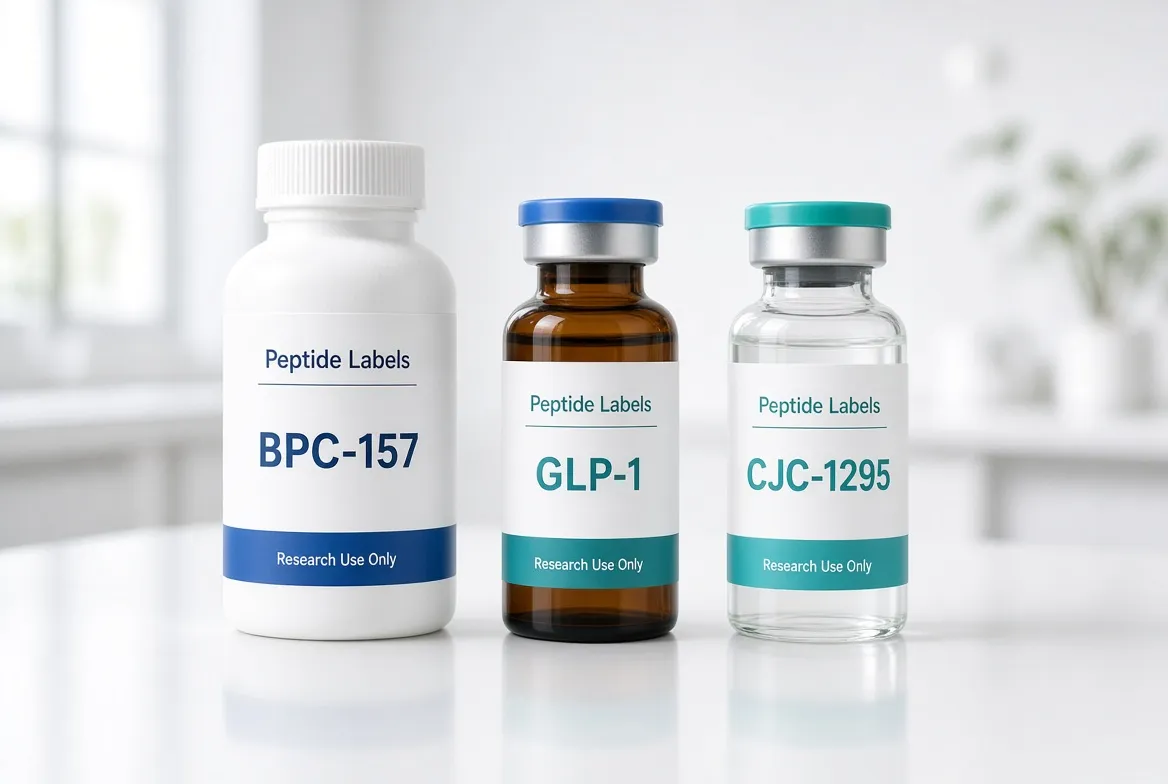
Vitamin and supplement bottle label sizes follow the bottle, not the brand, and the bottle’s straight wall decides every dimension on the quote. Vitamin and supplement bottle label sizes start from two measurements: the wall height and the circumference, and every reference chart below is built from those two numbers.
This guide walks the sizing process in order. The bottle capacities and shapes, the reference dimensions by size, the fit problems that curves cause, the two main label layouts, and the measurement that confirms everything each get a section. The charts are starting points, and the real bottle always gets the final word.
Common Bottle Capacities and Shapes for Supplements
The label size is decided by the bottle’s straight wall.
Supplement bottles cluster around a small set of capacities, from 2 oz dropper bottles up to 16 oz family-size packs. The capacity matters less than the geometry, because two 4 oz bottles with different shoulder shapes take different labels even at the same volume.
Brands that carry the same capacity across two bottle shapes often need two label sizes.
| Bottle Shape | Label Zone | Fit Notes |
|---|---|---|
| Cylindrical | Straight wall | Full wrap fits cleanly |
| Boston round | Curved shoulder | Keep text below the shoulder |
| Tapered | Sloped wall | Shorten the label or fit the slope |
| Square or oblong | Flat panels | Front-and-back pairs work well |
Why the Shape Matters Before the Size
The shape decides where the label can sit flat, and the size is simply that zone’s measurement. A Boston round has a usable straight wall below the shoulder, and the label height must stay inside it.
The brand that measures the whole bottle instead of the wall gets a label that wrinkles on the curve. The straight wall is the only zone that counts. A measured wall beats a remembered one, every time.
Reference Label Dimensions by Bottle Size
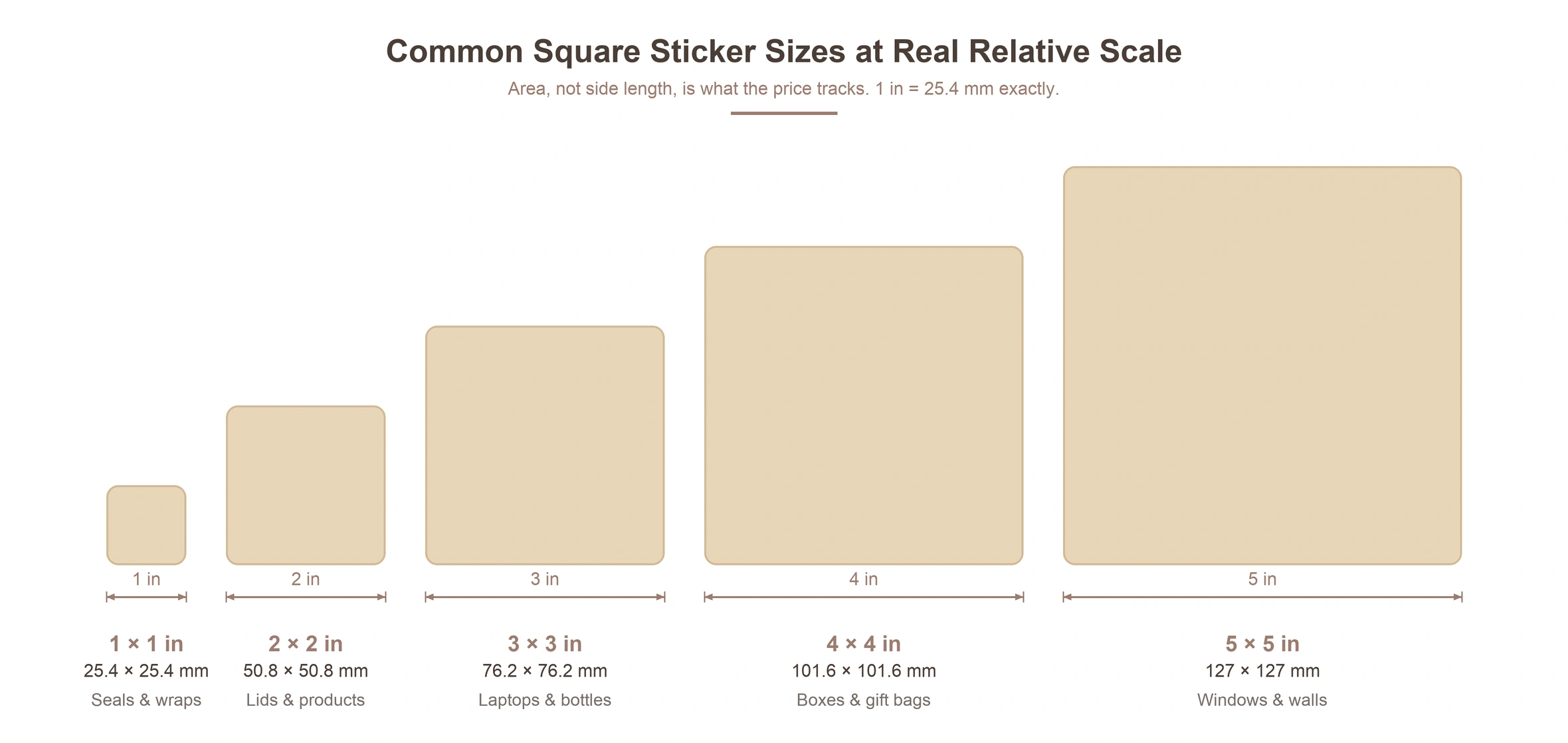
The reference chart below gives starting points, and the real bottle always gets the final word.
The table lists typical label dimensions for straight-walled cylindrical bottles at the capacities supplement brands use most. The ranges exist because bottle walls vary between suppliers even at the same capacity. Capacity is the map, and the wall is the terrain.
The width column is the wrap length, which follows the circumference plus a small overlap, and the height column is the wall height the label should not exceed.
| Bottle Capacity | Typical Wrap Length | Typical Label Height |
|---|---|---|
| 2 oz (60 mL) | 3.5 to 4 in | 1.5 to 2 in |
| 4 oz (120 mL) | 4 to 5 in | 2 to 3 in |
| 8 oz (240 mL) | 5 to 6 in | 2.5 to 3.5 in |
| 12 oz (360 mL) | 6 to 8 in | 3 to 4 in |
| 16 oz (480 mL) | 7 to 9 in | 3.5 to 5 in |
For the packaging-level view of how a label size fits the product as a whole, see our article on what label size should you choose for packaging. The size decision also sets the material budget, and the cost side follows in our article on supplement label printing costs. The size, the material, and the cost all hang off the same two measurements.
Label Fit Challenges from Shoulder, Taper, and Curvature
The shoulder and the taper eat label space in ways a flat proof never shows.
A label designed on a flat screen fits a flat bottle, and most supplement bottles are not flat. The shoulder curve lifts the label’s top edge, the taper slides it, and the curvature bends the artwork so text near the edge reads at an angle.
The fit problems below are the three that come back on every new bottle. Each one has a fix, and each fix is cheaper before the run than after it.
The Shoulder
The shoulder is where the bottle rounds into the neck, and the label must stop before the curve starts. Artwork that crosses the shoulder lifts and wrinkles within days. The fix is a label height measured to the shoulder line, with a small safety margin above the top edge of the printed panel. The margin reads as blank space, and it is the cheapest insurance on the label.
The Taper
A tapered bottle has no straight wall at all, and a rectangular label slides down the slope as it wraps. The fit options are a shorter label that stays inside the flattest band, or a die-cut shape that follows the taper. The flattest band is found by rolling the bottle and watching where the label edges lift. The measurement that matters is the wall angle, not just the circumference.
The Curve
Every cylindrical label wraps a curve, and the curvature bends horizontal text at the label’s edges. The flat flattest zone near the label’s center carries the critical reading lines, while the edges hold background art. The layout rule stays simple: important text, flat zone. Background art can bend, and required text cannot.
Wraparound and Front-and-back Label Layouts
A wraparound label circles the bottle in one piece and hides its seam on the back, while a front-and-back pair prints two separate labels on opposite panels.
The wraparound wins on bottles with a tall straight wall, and the pair wins on small or square formats where a full circle would crease.
The sleeve adds a third option to that choice, compared in our article on roll labels vs. shrink sleeves. The choice follows the bottle’s geometry, not a style preference.
The Wraparound
The wrap length equals the circumference plus a small overlap so the seam grips and the design closes. The seam sits on the back where the hand rarely looks, and the panel arranges itself to the left or right of that seam. The overlap also absorbs the printing tolerance, so the seam never opens on the shelf. The front reading zone then stays free of the join.
The Front-and-back Pair
The pair splits the content by function: the front carries the brand and the benefit, and the back carries the Supplement Facts panel and the directions. Each label sizes to its own flat panel, and the two never wrap past their corners.
The pair also reads faster on the shelf, because the shopper’s turn finds the panel without spinning the bottle. Small dropper bottles usually take this format. For the wide-mouth version of the same sizing work, see our article on gummy vitamin labels. For the tamper seals that pair with those formats, see our article on tamper-evident labels for supplements.
For the reading order that fills whichever surface the format provides, see our article on how to design professional supplement labels. The layout then inherits the size decision made from the bottle’s real measurements.
Bottle Label Sizes Confirmed Against Your Real Bottles
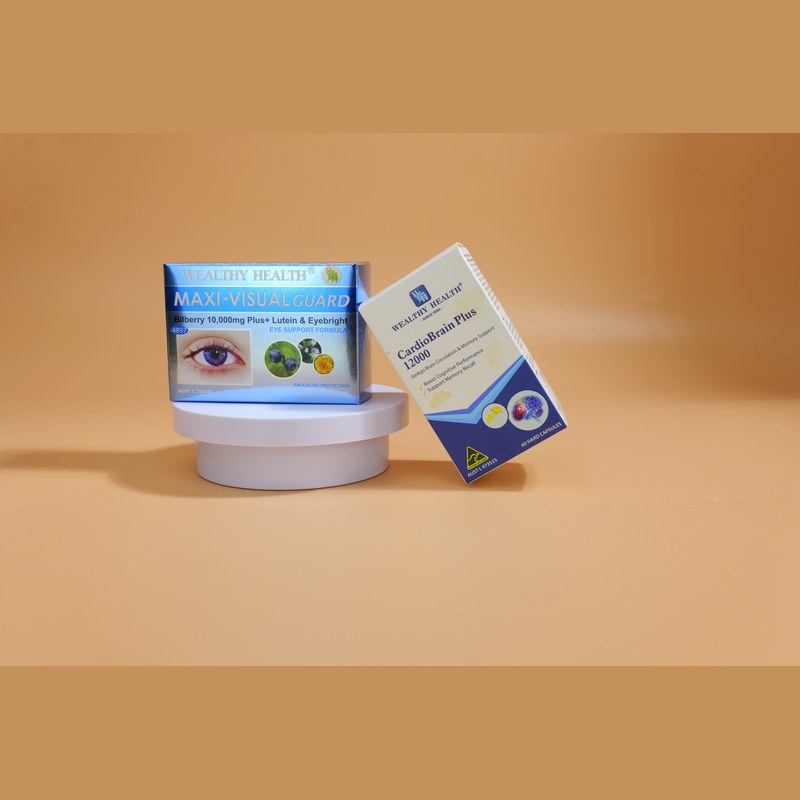
Bottle Measurement and Custom Label Size Confirmation
The measurement is the spec, and everything else on the label bends to it.
The confirmation step replaces every chart with two real numbers taken from the actual bottle: the wall height at the label zone, and the circumference at the same zone. No chart survives contact with the actual bottle. Industry packaging organizations such as IoPP keep the measurement discipline standard across the industry, and the supplier applies it to the artwork.
The Two Measurements
The wall height runs from the shoulder line down to the base stop, and the label height takes that number minus a small safety margin. The circumference runs around the bottle at the label’s vertical center, and the wrap length adds the overlap to it. Both measurements come from the same zone, never from the bottle’s widest point. The widest point overstates the wrap, and the tallest point overstates the height.
The Confirmation Loop
The artwork prints on a flat proof first, then the sample goes onto the real bottle and the edges get checked at the shoulder, the taper, and the seam. Anything that wrinkles, slides, or reads at an angle sends the size back for one adjustment. The loop closes only when the sample sits flat on the production bottle. One adjustment at sample stage costs minutes, and the same catch at production costs the run.
- Measure the wall height and the circumference at the label zone.
- Subtract the shoulder and base margins before the label height is fixed.
- Confirm the fit on a printed sample wrapped on the real bottle.
Häufig gestellte Fragen
What size should a bottle label be?
The label should fit the bottle’s straight wall: its height stays inside the wall, and its length follows the circumference plus a small overlap. Charts give starting points, but the bottle’s own measurements are the spec. A sample on the real bottle is the last word.
What is the typical size of a Vitaminwater bottle?
Vitaminwater bottles hold about 20 oz, with a tall straight wall that takes a full wraparound label several inches wide. The exact label size follows the bottle’s circumference and wall height rather than the brand name.
What size should I print my label?
Print at the size the bottle’s label zone allows, with the critical text sitting in the flattest part of the panel. The print size is the production size, never an enlarged screen version that hides edge problems. What prints is what the shelf sees.
What size label for a 4oz bottle?
A 4 oz bottle usually takes a label about 4 to 5 inches in wrap length and 2 to 3 inches tall, depending on its shoulder and wall. Measure the wall height and the circumference to confirm the exact pair of numbers. The shoulder and the wall settle the exact pair.
What size label for a 2oz bottle?
A 2 oz bottle takes a small label, often about 3.5 to 4 inches long and 1.5 to 2 inches tall. Dropper bottles in this size frequently use a front-and-back pair instead of a full wrap. The wrap length follows the bottle’s own circumference.
How do I know my bottle size?
Measure the straight wall from the shoulder line to the base, then wrap a tape around the bottle at the label’s center for the circumference. The capacity in ounces is the starting point, and those two measurements are the spec. Those two numbers go straight onto the quote sheet.
How big is a 60 mL bottle?
A 60 mL bottle holds about 2 oz and stands roughly 3 to 4 inches tall, with a straight wall of an inch or two below the shoulder. The label fits that wall, not the bottle’s full height. Dropper caps and necks stay clear of the printed zone.
What is the standard label size for a 10ml vial?
A 10 mL vial takes a very small label, often around 1.5 inches long and under 1 inch tall. The vial’s tiny wall leaves room for the product name and a code, and the full facts usually move to the carton. That split keeps the tiny print readable.
What size label for 50ml bottle?
A 50 mL bottle sits between the 2 oz and 4 oz formats, and its label usually runs about 3.5 to 4.5 inches long and 1.5 to 2.5 inches tall. The bottle’s own wall measurements confirm the pair. The capacity range overlaps because bottle shapes differ.
How to calculate label size?
Calculate the wrap length as the circumference plus a small overlap for the seam, and set the height from the straight wall minus the safety margins. The label size is those two numbers together. For the wholesale pricing that follows those numbers, see our article on wholesale supplement bottle labels. The supplier applies both numbers to the artwork.
Conclusion
Vitamin and supplement bottle label sizes are a measurement problem. The wall height and the circumference decide the dimensions, the shoulder and the taper decide the margins, and the seam decides the layout. The brands that measure first and confirm on a real sample avoid the whole family of wrinkles, slides, and reprints that follow a guessed size.
For brands sizing labels across a vitamin or supplement range, Meikei confirms every dimension against the real bottles and proofs the fit on the production container before the run. The sample then travels with the approval, so production matches what was actually confirmed.