Wine label sizes need to suit the bottle format, from the 187.5 ml split served on airplanes to the 1.5 L magnum that anchors a dinner table. Each format has a body shape that suits it, and each bottle shape has label dimensions that look right on it.
This chart connects the two things wine brands search for: how big each bottle is, and what label fits it. Materials, клеи, and bottle choice are covered in the guide to choosing bottle labels. Here we stay with sizes, first by bottle format, then by label position on the bottle.
Wine Bottle Sizes Chart
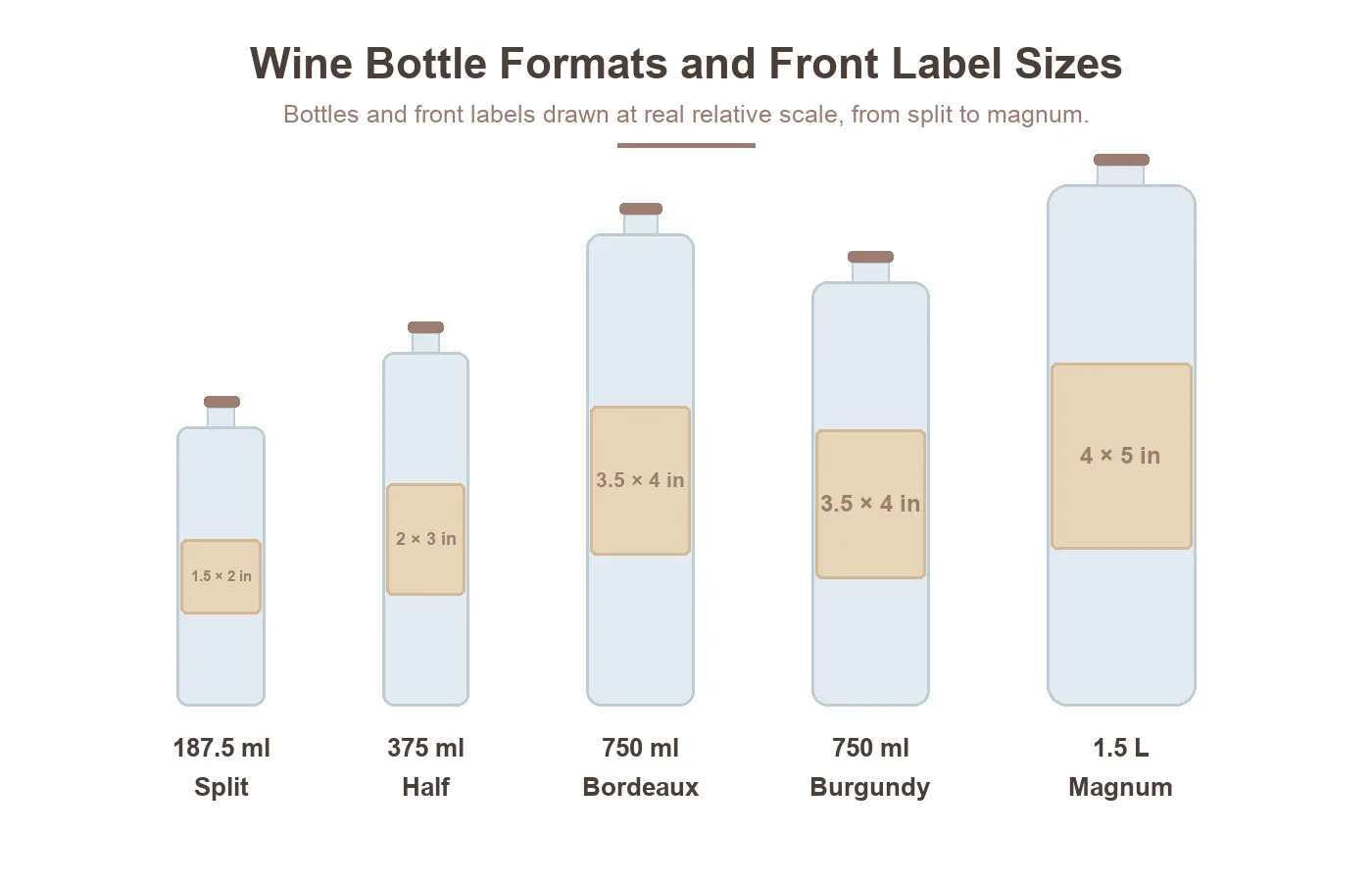
Six bottle formats cover the whole wine shelf, and each has a label size that suits it.
Wine bottle capacity is measured in milliliters, and the same capacity can come in more than one body style: the straight-sided Bordeaux and the rounder Burgundy both hold 750 ml. The heights and diameters below are reference values from standard glass supply listings, so treat them as a starting point and confirm against your actual bottle.
| Формат | Capacity | Height | Diameter |
|---|---|---|---|
| Split / Piccolo | 187.5 ml | 7.5 in / 191 mm | 2.375 in / 60 mm |
| Half / Demi | 375 ml | 9.5 in / 241 mm | 2.25 to 2.4 in / 57 to 61 mm |
| Bordeaux | 750 ml | 12.7 in / 322 mm | 2.9 in / 73.6 mm |
| Burgundy | 750 ml | 11.4 in / 289 mm | 3.15 in / 80.2 mm |
| Magnum | 1.5 L | about 14 in / 355 mm | about 4 in / 102 mm |
| Double Magnum / Jeroboam | 3 L | about 19 in / 483 mm | about 5.3 in / 135 mm |
187.5 ml Wine Bottle
The split is a single serving, common on flights, in gift sets, and at hotel minibars. Its tiny body takes a 1.5 × 2 inch label, and most producers skip the neck label entirely because there is barely a neck to dress. Think of the split as a business card for the brand. It also labels quickly, since one small front panel is the entire job.
375 ml Wine Bottle
The half bottle serves two glasses and pairs well with tasting menus and dessert wines. A 2 × 3 inch front label fits its proportions, with a slim 1 × 2.5 inch neck band if the design calls for one. Half bottles reward restraint in label size, because the bottle itself is the delicate feature.
750 ml Wine Bottle
The 750 ml is the wine world’s default, in both the tall Bordeaux body and the rounder Burgundy body. Its roomier front panel carries a 3.5 × 4 inch label with room for typography, a crest, and vintage storytelling. Nearly every label convention people picture, the front label, the back label, the neck foil and band, is sized around this bottle.
1.5 L Magnum
The magnum doubles the 750 and turns the bottle into a statement piece for celebrations and cellaring. Labels scale up to a 4 × 5 inch front, and the extra body width means artwork can breathe. Magnums are often given oversize presentation treatment, since the bottle is bought to be seen.
Larger Wine Bottle Sizes
Beyond the magnum, the named sizes climb through the 3 L double magnum, the 4.5 L jeroboam in Champagne terms, and the 6 L imperial, up to the 15 L nebuchadnezzar. These are event and display bottles, and their labels are usually custom cuts sized to each glass mold, since no stocked die matches a bottle that size. If you are labeling large formats, plan on sharing exact bottle measurements with your printer.
Standard Wine Bottle Dimensions
Height and diameter differ by bottle style, even at the same 750 ml fill.
Two measurements define a wine bottle for labeling purposes: the overall height, and the diameter of the body. The Bordeaux body runs taller and slimmer, while the Burgundy body is shorter with a wider belly and a sloped shoulder. Those differences matter at label time, because the shoulder curve starts at a different height and the usable panel changes with it.
A quick comparison makes the point. At 750 ml, the Bordeaux stands about 12.7 inches tall with a 2.9 inch body, and the Burgundy stands about 11.4 inches with a 3.15 inch body. The Burgundy’s wider body also means a longer circumference, so a wrap-style label that closes neatly on a Bordeaux can fall short on a Burgundy. Same wine volume, different label math.
Between molds, diameters also drift by a millimeter or two, which is why printers ask for the actual bottle rather than the format name whenever a wrap is involved. Estates that switch glass suppliers mid-vintage sometimes discover this the hard way, on a wrap that no longer closes. For front and back panels the drift rarely matters; for anything sized to the circumference, it decides the job.
Wine Bottle Label Sizes by Bottle Size
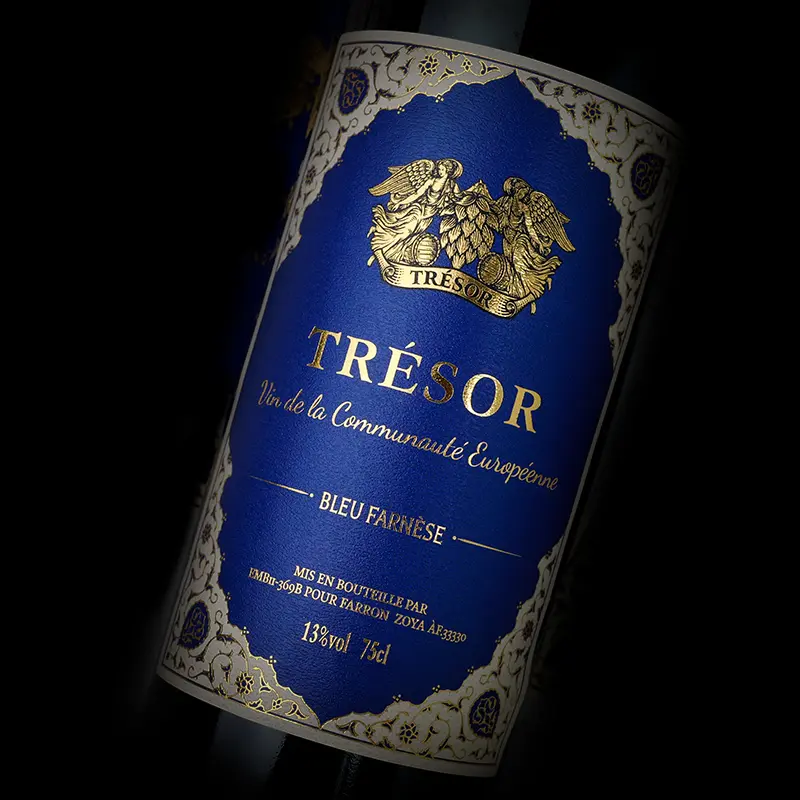
Front label sells, back label explains, neck label flatters; each has its own size.
Front Label
The front label is the sales panel, and its size tracks the bottle. Splits carry 1.5 × 2 inches, halves 2 × 3, standard 750s carry 3.5 × 4, and magnums carry 4 × 5. The front label is where premium finishing earns its keep; the making of foil-stamped labels shows why wine fronts pair so naturally with metallic accents.
Back Label
The back label carries the storytelling and the required small print: tasting notes, varietal details, importer information, and government warnings. It usually runs one step smaller than the front, such as 3 × 4 inches on a 750. In the United States, what must appear on wine labels is set by the TTB, the federal agency that regulates wine labeling, so the back panel is sized with that checklist in mind.
Full-Wrap Label
A full-wrap label circles the bottle in one piece, with the design continuing across the seam. It suits modern, graphic-driven brands more than traditional estates, and it must be cut to the specific bottle’s circumference plus a short overlap. Wraps shine on slim Bordeaux bodies and get tricky on wide Burgundy bellies, where the artwork distorts more as it bends. Sparkling formats, with their wider girths, follow the same caution.
Print Wine Labels Sized to the Glass
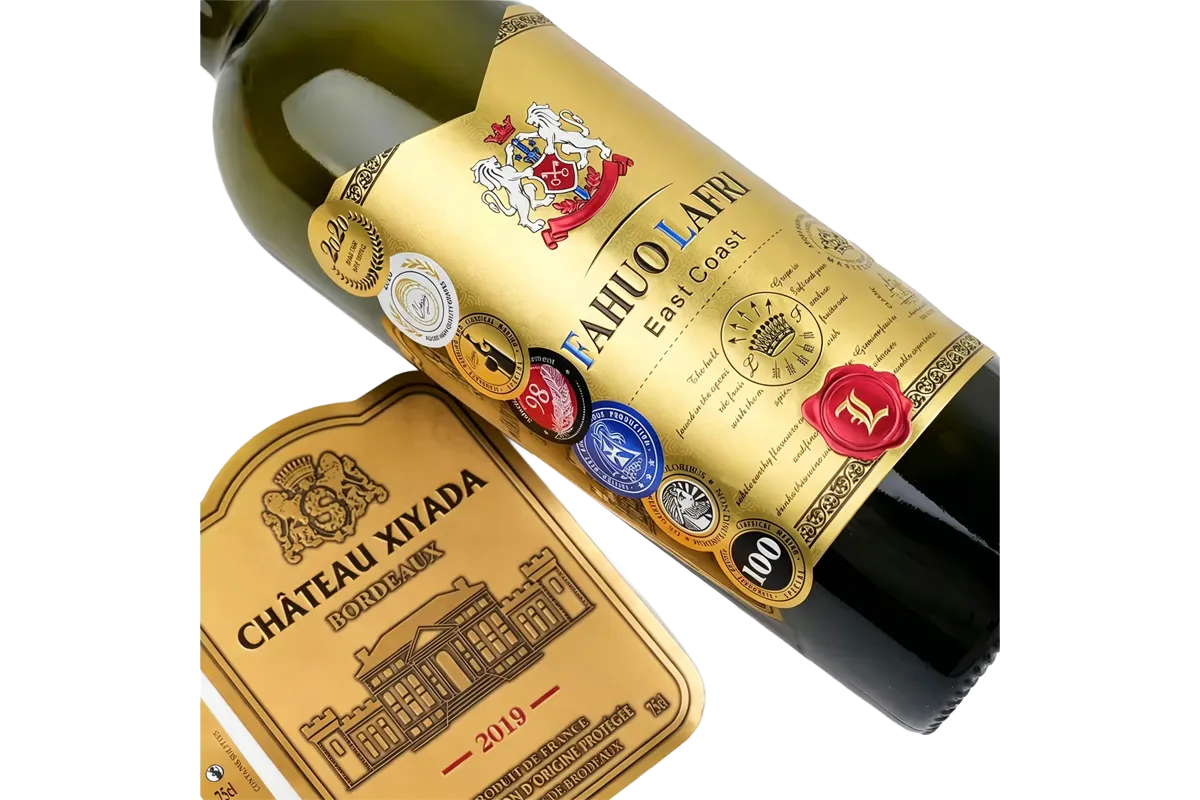
How to Measure a Wine Bottle for a Label
A wine bottle hides its usable panel in two curves: the shoulder and the base.
Measuring a wine bottle takes a tape measure and two minutes. For label height, measure the straight body between the shoulder curve above and the base curve or punt below. That band is the panel, and the label must fit inside it with breathing room on both ends. For wrap width, circle the tape around the body at label height to get the circumference.
Write the numbers down as width first, then height, the same convention used across labeling. And measure the actual production bottle, not a sample from a different mold run, because glass diameters drift slightly between production batches. The same care applies to every container category, and the broader method is laid out in choosing a label size for packaging.
What Size Label Fits a 750 ml Wine Bottle?
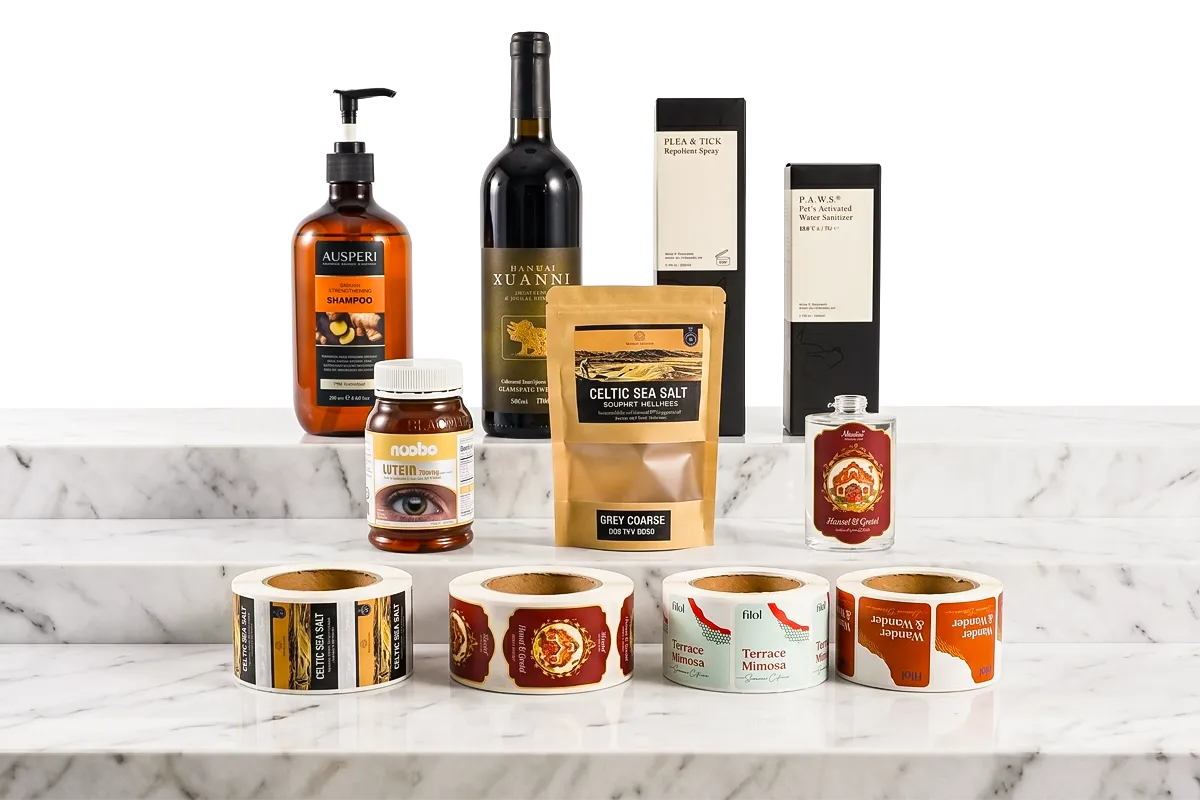
For a 750 ml bottle, 3.5 × 4 inches is the front label that always works.
The standard 750 setup is a 3.5 × 4 inch front label, a 3 × 4 inch back label, and a neck band around 1.5 to 2 × 3 to 3.5 inches. That combination fits both the Bordeaux and Burgundy bodies and leaves clean glass visible at the shoulder and base, which is part of the look buyers associate with wine.
Small adjustments are normal. Estates with minimal designs sometimes drop to a 3 × 4 front, and illustration-heavy brands run taller when the bottle’s straight panel allows. The neck label is optional in a way the front and back are not: plenty of successful wines skip it entirely and spend the budget on paper and finish instead. Designers often mock both labels on one sheet at final size, so the pair reads as a set from across the shelf.
Wine Label Bleed and Printing Area
Bleed is the margin that keeps white slivers off the edge of a wine label.
Two zones exist inside every label file. The cut line is the exact finished size from the charts above, and the safe area sits about an eighth of an inch inside it, where text and logos belong. Outside the cut line sits the bleed, artwork extended another eighth of an inch past every edge, which the printer trims away.
Bleed exists because cutting has tiny physical variation, and the extended artwork absorbs it. A wine label sent at exactly 3.5 × 4 inches with no bleed can show hairline white edges after cutting and curving onto the bottle. Build the file at final size plus 0.125 inches of bleed on all sides, keep text 0.125 inches inside the cut, and the label prints clean every time. The same file rules apply to neck bands, whose narrow shape makes a missing bleed proportionally more visible.
FAQ About Wine Bottle and Label Sizes
What Is the Standard Size of a Wine Bottle?
The standard wine bottle is 750 ml, sold in a taller, slimmer Bordeaux body about 12.7 inches high or a shorter, wider Burgundy body about 11.4 inches high. Common formats range from the 187.5 ml split to the 1.5 L magnum and larger.
How Tall Is a 750 ml Wine Bottle?
A 750 ml Bordeaux bottle stands about 12.7 inches (322 mm) tall, while a Burgundy body stands about 11.4 inches (289 mm). Molds vary slightly by glass supplier, so confirm against your production bottle.
What Size Label Fits a 750 ml Wine Bottle?
A 3.5 × 4 inch front label with a 3 × 4 inch back label is the standard pairing for a 750 ml bottle. Neck bands of about 1.5 to 2 × 3 to 3.5 inches complete the traditional three-label setup.
How Big Is a Magnum Bottle?
A magnum holds 1.5 liters, twice a standard bottle, and stands about 14 inches tall with a body around 4 inches wide. Front labels scale up to about 4 × 5 inches to match.
What Is a Standard Wine Label Size in mm?
A standard 750 ml front label of 3.5 × 4 inches measures 88.9 × 101.6 mm, and the 3 × 4 inch back label measures 76.2 × 101.6 mm. Conversions are exact because one inch equals 25.4 mm.
How Far From the Bottom Should a Wine Label Sit?
Leave roughly half an inch to an inch of clear glass between the label’s bottom edge and the base, and keep the top edge below the shoulder curve. This keeps the label on the straight panel, where it lies flat and looks intentional.
What Information Must Appear on a Wine Label?
In the United States, the TTB requires the brand name, class or type of wine, alcohol content, net contents, sulfite declaration, and the bottler’s name and address. Health warnings must also appear on the container. Check current TTB rules before finalizing the back label layout.
Conclusion
Wine bottle sizes are a settled vocabulary, from the 187.5 ml split to the magnum and beyond, and every format in between has label dimensions that simply look right: 1.5 × 2 on a split, 2 × 3 on a half, 3.5 × 4 front with 3 × 4 back on a 750, and 4 × 5 on a magnum.
Confirm the body style before ordering, because Bordeaux and Burgundy differ in height and circumference at the same fill, and build every file with an eighth of an inch of bleed. Beyond that, the chart above does the remembering for you.
After the format and label sizes are decided, get a printed proof from Meikei on your actual glass. Dimensions, paper, and finish come back confirmed before the full run starts.