Tamper-evident labels for supplements exist to make opening visible, and the whole category rests on that one idea: the package shows the attempt. Tamper-evident labels for supplements come in a short list of formats, and each one leaves its own kind of evidence behind.
This guide walks the formats in order: the purpose they serve, the label and seal types, the three constructions, the placement rules, and the pre-shipment checks. Each section explains what the feature has to prove and how the print job delivers it. The formats below are the working set every supplement brand chooses from.
Purpose of Tamper-Evident Features on Supplement Packages
Tamper evidence is not a lock, it is a witness, and the witness has to be visible.
A tamper-evident feature does not stop someone from opening the bottle. It makes the opening leave a mark that the next person can see, so a compromised package never reaches the shelf unnoticed. The mark is the product, and the label’s only job is to make that mark obvious. Everything else on the package is secondary to that job.
The Trust Contract
The seal carries a simple promise: what is inside has not been touched since it was filled. The design rule follows from that promise, because the feature must be impossible to remove and reapply invisibly. A resealable feature defeats the purpose, and a hidden feature protects no one. Every format below is judged against exactly that test.
The Regulatory Neighbors
Medication seals trace their modern standard to the rules written after the 1982 cyanide cases, and the requirement still stands for over-the-counter drugs in federal regulation. Dietary supplements sit beside that rule rather than under it, but the shopper’s expectation is identical, which is why supplement brands adopt the same features. The expectation travels faster than the regulation, which is why the practice is nearly universal.
Common Label and Seal Formats for Bottles and Jars
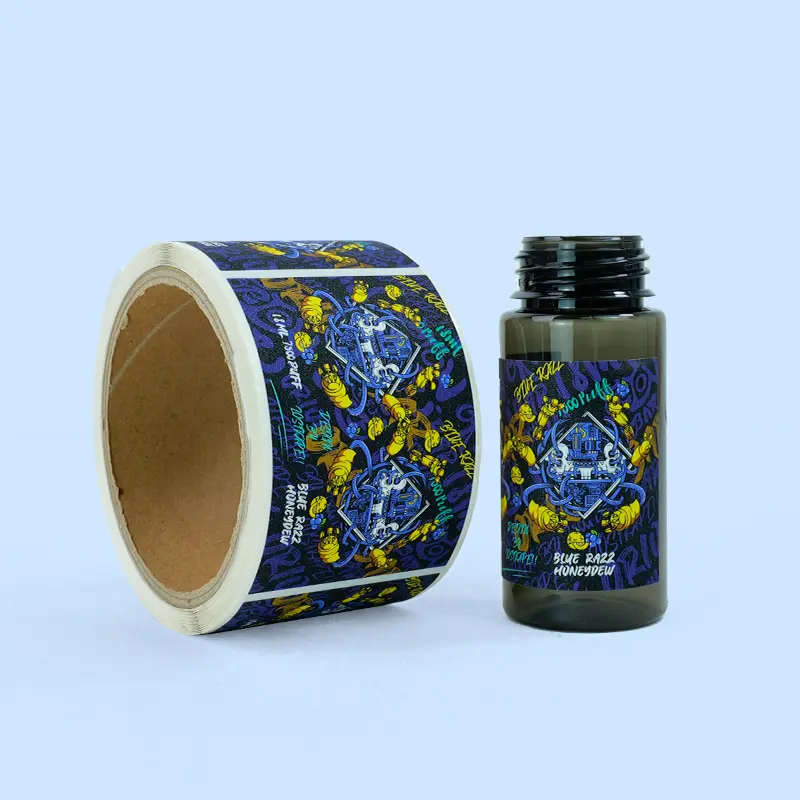
The format list is short, and each format answers a different part of the same promise.
Supplement bottles and jars use four working formats. The shrink band goes over the cap, the seal label bridges the cap and the body, the induction seal sits inside the mouth, and the full sleeve carries a perforated strip. Most supplement programs combine two of them, because no single format covers every opening path.
Shrink Bands and Neck Seals
The shrink band wraps the cap and the neck in one piece of film, and the shopper must tear it before the cap turns. The tear is the evidence. Bands suit round caps and jars where the geometry gives the film a clean place to grip. The print on the band usually repeats the brand or the seal message.
Seal Labels and Induction Seals
The seal label bridges the cap and the bottle body with a pressure-sensitive label that breaks when the cap turns. The induction seal sits inside the bottle mouth under the cap and must be peeled or pierced. One shows the attempt on the outside, the other proves the inside stayed closed. Together they cover the two directions an opening can come from.
The sleeve format carries the same protection built into its film, and the comparison against roll labels is covered in our article on roll labels vs. shrink sleeves. The band and the seal label are the two roll-based answers to the same need.
Breakaway, Void, and Destructible Constructions
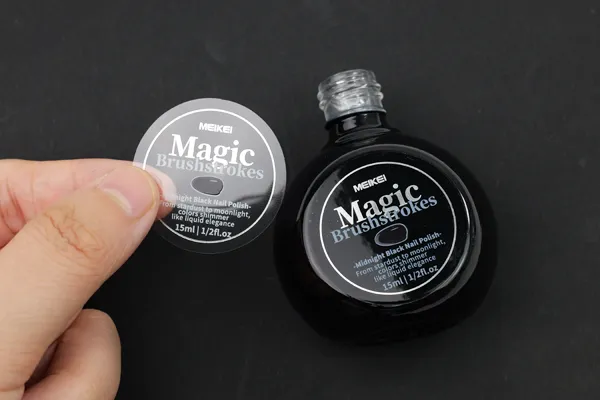
The construction decides what the label leaves behind when someone tries to remove it.
Pressure-sensitive tamper labels come in three constructions, and the difference is what survives removal. The breakaway construction tears itself, the void construction leaves a printed message on the surface, and the destructible construction shatters into pieces. Each one is chosen by the surface it guards. The surface decides, and the supplier confirms with a test.
Breakaway Labels
A breakaway label is die-cut so the middle of it has no strength: lifting one edge tears the label in two, and it cannot be reapplied as a whole. The torn halves are the evidence. The construction suits flat panels where the label sits proud and visible. The tear happens before the label can travel an inch.
Void Labels
A void label lifts off the surface in one piece but leaves its message behind, usually the word VOID repeated in the adhesive layer. The evidence stays on the product after the label is gone. Void film suits smooth caps and closures where a torn label could be brushed off and ignored. The message survives the removal, which is the point.
Destructible Labels
A destructible label shatters into small fragments when anyone tries to peel it, because the facestock has no internal strength. The fragments prove the attempt instantly. The construction is the strongest of the three, and it costs the most per label. High-value lines buy it for the same reason they buy the strongest cap.
Placement Options Around Caps, Neck Bands, and Closures
Placement is half the function, because a seal nobody can see protects nobody.
The feature must sit on the opening path, not somewhere decorative. For a screw cap, the path runs through the cap-to-body junction, so the band or the seal label lives exactly there. Placement follows the mechanical fact of how the package opens, and everything else is decoration. The shelf position of the seal is a bonus, never the starting point.
Caps and Junctions
The cap junction is the highest-value placement, because every opening passes through it. The band covers the cap and the neck together, or the seal label bridges the two, and either way the turn that opens the bottle must tear it. The junction placement also reads naturally on the shelf, where the shopper’s eye already goes. A seal elsewhere asks the shopper to hunt for it.
Jars, Tubs, and Non-round Closures
Jars and tubs take a band over the lid rim or a seal label across the lid edge, because the opening path is a lift rather than a turn. Non-round closures need the label placed across the shortest opening line, where the first peel breaks it. The placement rule stays the same: cover the opening path. For the gummy bottle that hosts that junction, see our article on gummy vitamin labels. Every lid design has one shortest opening line, and the label sits across it.
The geometry underneath that placement comes from the bottle’s real measurements. For the size chart that locates the label zone on each bottle, see our article on vitamin and supplement bottle label sizes. The seal then inherits the same zone plus the cap junction.
Tamper-Evident Seals That Leave Real Evidence

Checking Seal Function and Label Integrity Before Shipment
The shipment check is the seal’s first test, and it happens before the bottle leaves the door.
A seal that tears too easily breaks in transit, and one that tears too hard annoys the customer, so the check tests both directions. The pre-shipment routine pulls samples from the line, opens them the way a shopper would, and reads the evidence left behind. The three checks below run on every batch. The batch size does not change the routine.
The Open Test
The checker opens the package with normal hand force and confirms the seal breaks cleanly along its intended path. A band that slips off the cap instead of tearing fails the test. The tear line follows the perforation or the die cut, never a random path. The evidence must appear exactly where the design says it will.
The Reapplication Test
The checker tries to reapply the torn band or the lifted label and confirms the attempt is visible. If the piece sits back into place and looks whole, the feature failed its one job. The test is scored as a pass only when the repair is obvious. The reapplication test catches exactly the trick a real tamper attempt would use.
The Transit Test
A packed carton goes through a drop and vibration cycle to confirm the seals survive shipping intact. Seals that open on their own in transit teach customers to ignore seals, which is worse than having none. The transit test protects the feature’s meaning. The packed carton runs the cycle, and the unopened seals come out of it.
The seal’s placement and sizing also have to work with the rest of the label program. For the reading order that leaves the cap junction clear for the seal, see our article on how to design professional supplement labels. The seal and the panel then share the bottle without fighting.
Frequently Asked Questions
What is a tamper sticker?
A tamper sticker is a label designed to break, tear, or leave a message when someone tries to remove it. The visible damage is the evidence that the package was opened. The sticker’s whole job is to make that attempt impossible to hide. Every construction in the category serves that one outcome.
What is an example of tamper-evident packaging?
The shrink band over a bottle cap and the induction seal under the cap are the two classic examples. The band must be torn before the cap turns, and the inner seal must be peeled or pierced. Both leave the opening visible.
What are tamper-evident labels?
Tamper-evident labels are pressure-sensitive labels built to show removal, through breakaway cuts, void messages, or destructible facestocks. They seal the cap to the body or the lid to the rim. The construction decides what evidence the removal leaves. The three constructions differ only in that evidence.
What is the difference between tamper proof and tamper-evident?
Tamper proof claims the package cannot be opened, while tamper-evident only promises that an opening will show. Real packaging uses the evident standard, because no seal stops a determined hand. The difference is honesty about what a seal can do. Buyers learn the wording and check for the evident version.
What do anti-Tamper seals do?
Anti-tamper seals show that a package has been opened by breaking in a way that cannot be restored invisibly. The broken band or the void message is the signal. Their job is evidence, not prevention.
What is the purpose of a tamper-evident seal?
The purpose is to make an opening visible to the next person who handles the package. The seal carries the promise that the contents have not been touched since filling. A seal that fails to show the attempt has failed its purpose. The promise only survives if the evidence does.
How does a tamper seal work?
The seal sits across the package’s opening path, so the motion that opens the package must tear or break it first. The break is one-way, because the pieces cannot rejoin invisibly. The visible damage is the whole mechanism.
Why did they start putting seals on medications?
Seals became standard after the 1982 tampering cases, when cyanide was added to opened bottles of over-the-counter pain medicine. The regulation that followed requires tamper-evident packaging on most over-the-counter drugs. Supplement brands adopted the same features for the same shopper trust. The aisle does not separate the two expectations.
Are tamper seals required?
Tamper-evident packaging is required for most over-the-counter drugs, while dietary supplements carry no identical federal mandate. The shopper’s expectation is the same in both aisles, so supplement brands treat the seal as a requirement in practice.
Is tamper evident packaging required for food?
Most foods carry no blanket federal tamper-evident mandate, though specific categories and retailers add their own rules. The practice is driven by brand policy and customer expectation more than by regulation. Supplements follow the same voluntary logic. Retailer requirements often add what federal rules leave open.
Conclusion
Tamper-evident labels for supplements are a small print investment that carries the whole trust contract of the bottle. The format covers the opening path, the construction leaves visible evidence, and the pre-shipment checks prove both directions before the first carton leaves. For the full type list security labels belong to, see our article on types of product labels. The seal that survives the tests is the one shoppers learn to trust, and that trust is what the label was bought for.
For supplement brands adding or upgrading seals on caps, 항아리, and tubs, Meikei specifies the band or the label against the real closure geometry. The open, reapplication, and transit checks all run before shipment.