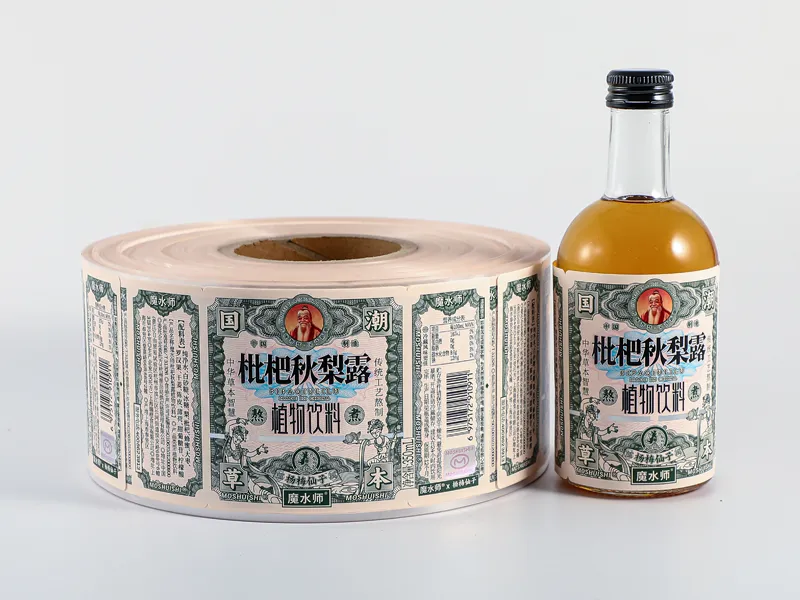
Choosing the right roll label is an important part of achieving smooth and consistent product labeling. For FMCG brands and consumer packaging applications, factors such as label material, गोंद, liner strength, core size, and unwind direction can all affect how labels feed and apply on automated or semi-automated equipment. Selecting specifications that match the packaging format and application process can help reduce feeding and placement issues during production.
This guide explains how to choose roll labels for automated and semi-automated application. It covers BOPP, PET, paper facestocks, adhesive selection, liner strength, core dimensions, unwind direction, and other specifications that affect feeding and placement performance.
What Are Custom Roll Labels
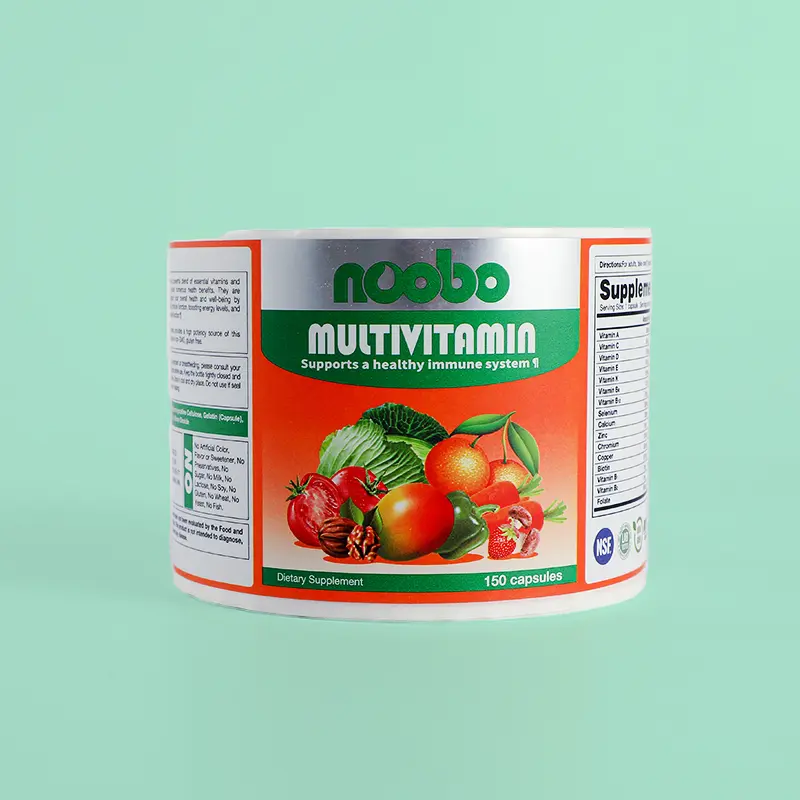
Custom roll labels are pressure-sensitive identifiers wound onto a continuous core, engineered specifically to maximize application speed and placement consistency on automated packaging lines.
Definition and Physical Format
Custom roll labels are pressure-sensitive labels produced to specific packaging and branding requirements and wound onto a central core rather than supplied as individual sheets. This format is well suited to products that require consistent label placement, efficient handling, and compatibility with automated or semi-automated application processes.
The labels are supplied on a continuous release liner for clean handling and space-saving storage. During manufacturing and storage, this liner acts as a stable carrier web, keeping the adhesive protected until the exact moment of application.
Each roll is die-cut into precise shapes and sizes, ready for fast, repetitive application processes. The waste matrix is stripped away during converting, leaving clean, individual labels separated by a highly consistent gap for reliable mechanical detection.
Core Components and Materials
Selecting the right construction requires matching physical components to your specific operating environment. The final performance relies heavily on three core elements:
- Face stocks: Options range from cost-effective paper for dry, short-life applications to durable synthetic films like BOPP, विनाइल, and PET for moisture and chemical resistance.
- Adhesives: Specialized pressure-sensitive adhesives are selected based on service environments, including permanent, removable, repositionable, and deep-freeze options.
- Core sizes: Standard core sizes are typically 1 inch or 3 inches in inner diameter to fit various manual, semi-automatic, and fully automated dispensing systems.
Key Advantages Over Sheet Labels
In commercial packaging setups, the choice between rolls and sheets dictates your entire operational throughput. Roll labels deliver significantly faster dispensing speeds, which reduces overall labor and packaging time compared to peeling labels from flat grids.
Roll-wound stock is highly compatible with semi-automatic and automatic labeling machinery to ensure consistent placement. This mechanical alignment eliminates human placement errors, such as crooked labeling or wrinkling on curved bottle and jar surfaces.
The continuous roll format supports efficient label handling and consistent application across different packaging processes. It is suitable for both standard and customized labels, including product information, ब्रांडिंग, barcodes, and other variable content where required.
Common Industry Applications
Virtually every high-throughput product packaging sector relies on rolls to maintain steady supply chain logistics and brand presentation:
- Food and beverage packaging: Used for brand identification, nutrition panels, and ingredient lists on containers that encounter condensation or cold storage.
- Cosmetic and personal care: Applied to squeezable and curved containers requiring oil-resistant films, flexible label stocks, and water-safe adhesives.
- Pharmaceuticals and supplements: Deployed for regulatory compliance, batch coding and precise tracking through automated scanning lines.
Custom Roll Labels vs Sheet Labels
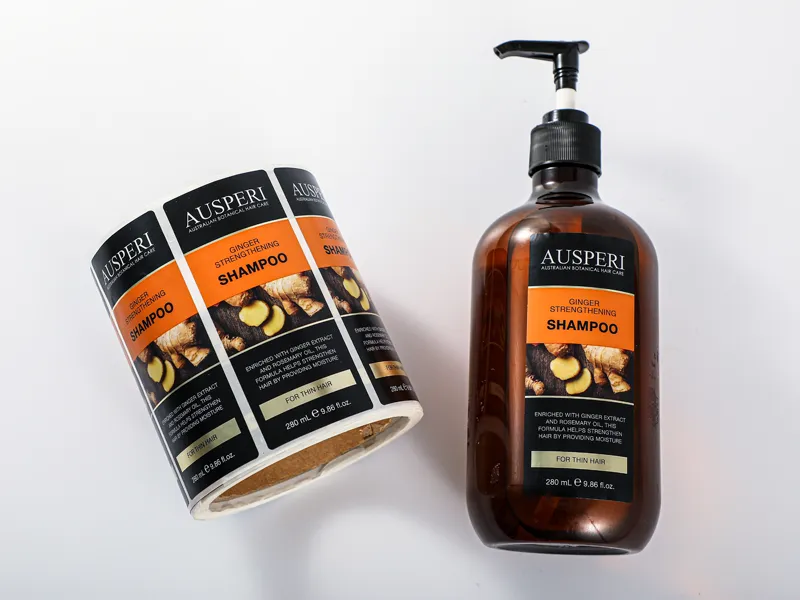
Application method dictates your format choice: rolls feed automated machinery and high-speed dispensers, while flat sheets limit operations to manual hand placement.
Core Format Differences and Supply Forms
Selecting the wrong label format can halt a packaging line before it even starts. Custom roll labels consist of individual designs printed on a continuous backing liner, wound tightly around a centralized cardboard or plastic core. This setup is fundamentally different from sheet labels, which feature pre-cut designs arranged in a grid pattern on flat, standardized carrier sheets like A4 or US Letter.
To prevent mechanical failures on the production floor, roll configurations require strict adherence to specific physical parameters. Buyers should verify the following structural requirements prior to manufacturing:
- Core Diameter: Typically standardized at 1 inch or 3 inches to fit secure machine spindles.
- Maximum Outer Diameter: The total roll thickness limit designed to physically clear printer or applicator enclosures.
- Unwind Direction: The orientation of the exiting label design relative to the machine’s feed path.
Sheet formats avoid these mechanical constraints entirely by keeping multiple kiss-cut labels perfectly flat. This flat profile makes sheet labels incredibly compact and easy to store in standard office drawers or filing cabinets, requiring no specialized warehouse racking.
Workflow Mechanics and Application Efficiency
The choice between roll and sheet labels largely depends on the intended application method and packaging volume. Roll labels are suitable for automatic, semi-automatic, and manual dispensing systems, with the continuous liner helping support consistent feeding and label placement.
For manual packaging operations, desktop dispensers can make roll labels easier to handle by separating labels from the liner as they are dispensed. This can improve application efficiency compared with manually peeling individual labels from sheets, particularly for larger packaging runs.
Sheet labels can be practical for smaller quantities or applications where labels are applied individually by hand. As order volumes increase, roll labels may offer a more convenient format for repetitive labeling and packaging operations.
Economic Thresholds and Production Volume Criteria
At equivalent order volumes, the raw printed cost per label is highly comparable between rolls and sheets. The true economic divide emerges when you calculate the labor hours required to apply the finished product to your packaging.
For larger quantities of the same SKU, the operational speed of roll dispensing rapidly offsets the initial machine setup or die tooling overhead. However, when managing complex, multi-SKU orders with very low quantities per design—such as ten different product scents requiring 100 labels each—sheet labels offer a lower total cost of entry. They bypass the technical winding setup fees that printers charge for small roll batches.
Material Performance and Quality Control Standards
Roll labels for consumer packaging typically use paper or synthetic facestocks, suitable release liners, and adhesive systems selected for the product surface and application environment. For cosmetics, beverages, food, मोमबत्तियाँ, और उपहार उत्पाद, the focus is usually on reliable application, moisture or condensation resistance, उपस्थिति, and storage conditions.
Quality control for custom rolls requires precise technical verification before the press runs. Operators must check several critical benchmarks to prevent costly downtime on automated packaging lines:
- Label Gaps: Consistent spacing between labels helps the applicator sensor detect individual labels accurately.
- Unwind Direction: If the roll unwinds backwards, labels will apply upside down on the conveyor.
- Barcode Readability: High-speed scanners must read codes instantly, requiring zero print bleeding or registration shifts.
Strategic Recommendations for Brand Scaling
Startups and growing brands should treat sheet labels as a low-risk, high-flexibility option. They are ideal for initial product testing, seasonal marketing campaigns, and multi-design promotional packs where packaging artwork changes frequently.
You should transition to custom roll labels once your product formulas stabilize and volume demand justifies automated or semi-automated packaging equipment. Standardizing your mechanical roll specifications early in your design phase guarantees that your rolls will integrate seamlessly with downstream contract packagers and third-party logistics providers.
Scale Your Brand With Zero-Defect Labels
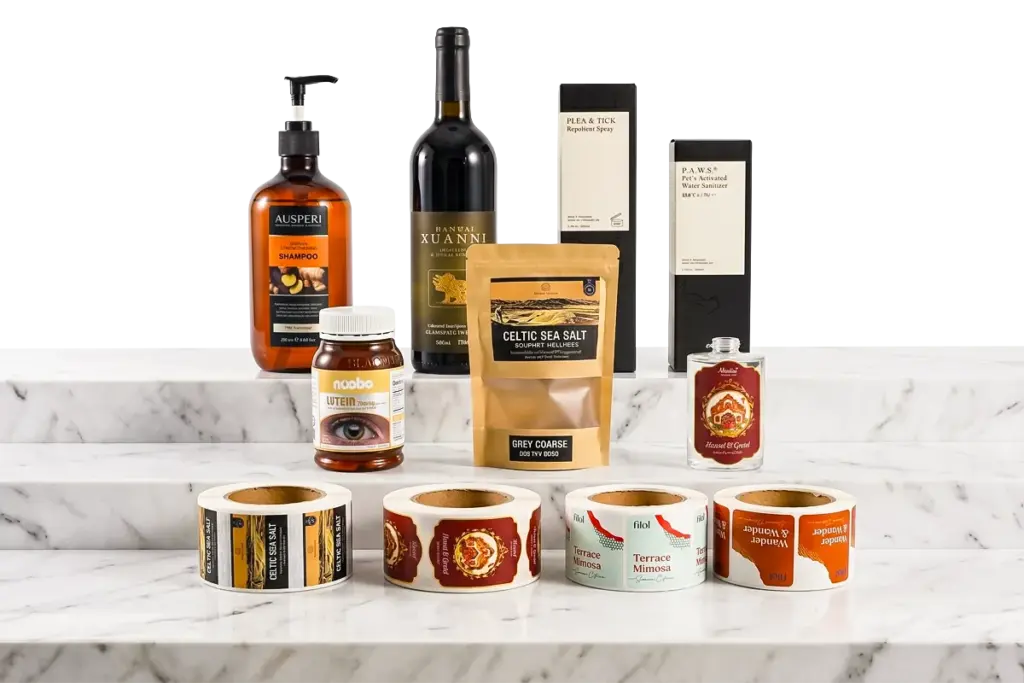
How Custom Roll Labels Support Machine Labeling
Automated packaging lines require custom roll labels engineered to precise mechanical tolerances to prevent tearing, sensor misreads, and costly production downtime.
Why Roll Formats Enable Automated Packaging
Manual labeling cannot sustain the throughput required for modern packaging lines. Transitioning to automated systems requires a continuous carrier format that interfaces directly with mechanical dispensing heads.
- Continuous roll supply: Continuous pressure-sensitive rolls supply automatic dispensers far more efficiently than individual flat sheets, maintaining constant web tension.
- Reduced handling times: Eliminating manual peeling reduces handling times and helps maintain clean, high-speed production runs free from human touch contamination.
- Consistent spacing: Consistent spacing on a wound backing paper keeps the labeling line moving without frequent stops or calibration adjustments.
Critical Machine Compatibility Requirements
Automatic labeling machines are highly rigid systems. If the roll geometry deviates from the physical limits of the applicator, the entire line halts.
- Core diameter sizes: Matching core diameter sizes of 1 inch or 3 inches prevents slipping on the applicator spindle during rapid acceleration.
- Maximum outside diameter: Calculating the maximum outside roll diameter ensures the physical roll fits inside the machine housing without rubbing.
- Unwind direction: Specifying the correct unwind direction and label orientation ensures graphics apply right-side up on the container.
Sensor Tracking and Feed Alignment
High-speed applicators rely on optical or capacitive sensors to detect where one label ends and the next begins. Misalignment here leads to double-feeds or offset placement.
- Optical sensors: Utilizing precise optical sensors that read physical gaps, liner backing colors, or registration marks controls dispensing cycles.
- Release tension: Controlling the die-cut release tension and liner strength prevents tearing during high-tensile pulls on the waste matrix.
- Liner transparency: Avoiding sensor misreads by matching liner transparency and backing materials directly to the machine’s detection system.
Application Performance and Container Verification
A label must bond instantly upon contact. Because automated applicators apply pressure for only a fraction of a second, the chemistry of the adhesive must match the substrate perfectly.
- Specialized adhesives: Selecting specialized adhesives that bond immediately to glass, PET, HDPE, or textured paperboard surfaces.
- Temperature alignment: Aligning material choice with application temperatures prevents wrinkling, bubbling, or edge-lifting in cold or hot-fill environments.
- Physical trials: Running physical trial rolls through the applicator and inspecting adhesion stability over 24 to 72 hours verifies long-term bond performance.
Choosing Roll Labels Materials and Adhesives
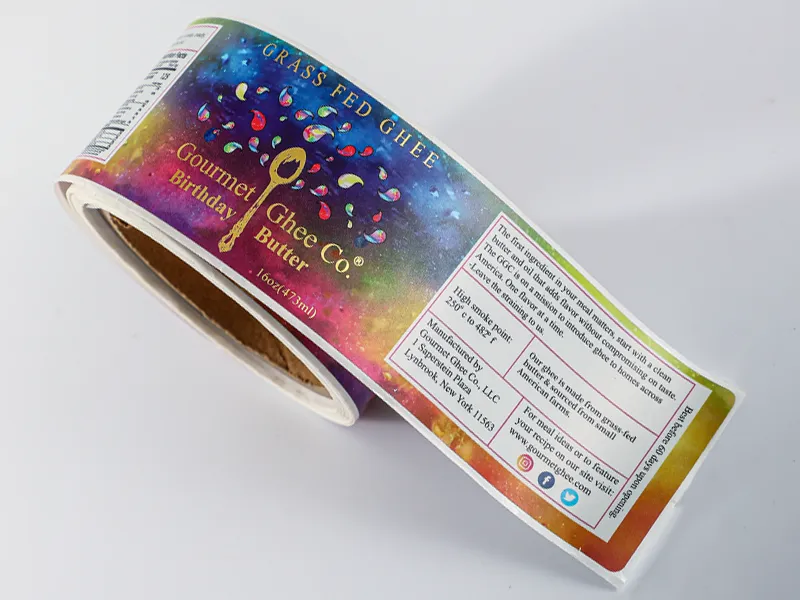
Matching facestock durability, adhesive tack, and liner strength to your container geometry prevents line downtime and labeling failures like edge lifting.
| सामग्री / Construction | Key Properties | Best Use Case |
|---|---|---|
| Coated/Uncoated Paper | Economical, high printability, zero moisture resistance | Dry, indoor shipping and retail pricing |
| बीओपीपी (Polypropylene) | Water and oil resistant, highly flexible, tear-proof | Chilled beverages, cosmetics, squeezable bottles |
| Polyester (PET) | Heat resistant, dimensionally stable, chemical durable | अंगराग, personal care, household, and product labels |
| Polyethylene (PE) | Flexible and conformable | Tube, cosmetic, and squeezable product labels |
Core Material Families and Facestock Selection
Selecting the right facestock determines how your label holds up to physical handling and environmental exposure. Paper and synthetic films behave differently under stress, meaning you must match the substrate’s physical properties to the life cycle of your package.
- Paper facestocks: Provide an economical, high-printability option for dry, indoor applications like shipping and retail pricing.
- Polypropylene (बीओपीपी) films: Offer excellent moisture and tear resistance, making them ideal for chilled beverages, cosmetics, and squeezable containers.
- Polyester (PET) सामग्री: Provide good dimensional stability and durability for cosmetic, personal care, household, and selected product labels.
- Polyethylene (PE): Offers flexibility and conformability for tubes, squeezable containers, and curved packaging.
Adhesive Chemistries and Performance Characteristics
Pressure-sensitive adhesives rely on molecular contact to build a bond. The chemical formulation determines whether the label grips instantly or cures over time, and how it responds to surface textures and temperature shifts.
- Acrylic-based adhesives: Deliver long-term durability, UV stability, and reliable temperature resistance for general product branding.
- Rubber-based adhesives: Offer high initial tack and strong immediate bond strength, especially on low-energy or rough surfaces.
- Surface energy compatibility: Low-energy plastics like PP and PE require softer, higher-tack formulations to wet out the surface and prevent edge lifting.
- Functional categories: Split options into permanent, clean-removal removable, or specialty deep-freeze and high-temperature formulations.
Matching Label Components to Substrates and Surface Geometry
Substrate chemistry and container shape dictate physical limits. Applying a stiff material to a curved or textured container creates mechanical stress that standard adhesives cannot overcome, resulting in immediate application failure.
- High-energy surfaces: Glass and metals bond easily with standard acrylic permanent adhesives, enabling sleek visual finishes like the no-label look.
- Porous or textured surfaces: Paperboard cartons and rough wood require higher adhesive coat weights to achieve adequate surface wet-out.
- Tight-radius curves: Tapered containers and squeezable tubes require highly flexible facestocks paired with soft adhesives to resist flagging.
Integration with Printing Methods and Application Equipment
A label construction must do more than look good on the shelf; it has to run through print engines and automated labeling lines without jamming or tearing. Every mechanical specification directly impacts machine uptime.
- Print technology compatibility: Determines surface topcoat requirements, matching digital, flexographic, or direct thermal/thermal transfer printing setups.
- Automated labeling lines: Require precise roll specifications, including specific core diameters, outside roll limits, and precise label-to-label spacing.
- Liner material choice: Directly influences dispensing reliability, with glassine paper liners serving standard applications and PET film liners supporting high-speed lines.
- Unwind direction and label orientation: Must align perfectly with automated application equipment to prevent production line bottlenecks.
Testing Protocols and Quality Control for New Formulations
Laboratory data sheets cannot replace physical line trials. Environmental factors in your packaging facility and the real-world transit cycle can cause unexpected adhesive failures if not tested systematically.
- Production line trials: Initial orders serve as physical tests of materials on the actual container surface under production conditions.
- The 24-to-72-hour testing window: Reveals potential adhesive curing issues, edge lifting, wrinkling, or environmental degradation.
- Performance verification: Includes subjecting labeled containers to real-world stress tests such as condensation, refrigeration, and abrasion.
How Manufacturers Produce High Volume Roll Labels
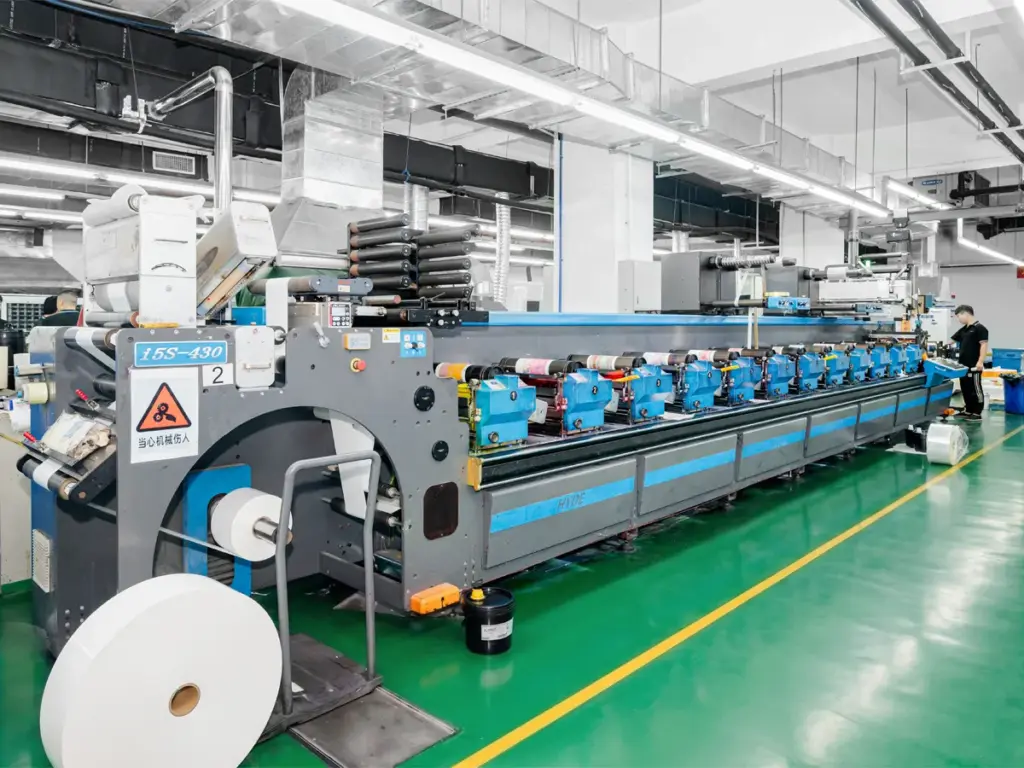
High-volume roll label production requires precise mechanical synchronization, matching exact roll geometry and materials to downstream automated application systems to ensure zero-defect packaging lines.
Prepress Setup and Technical Specifications
How does prepress setup impact high-volume roll label manufacturing? In high-speed packaging lines, even a millimeter of drift can halt an entire bottling system. Prepress setup must lock in the exact mechanical parameters of the target labeling equipment before the press runs a single meter of web.
Engineers first establish the physical limits of the label roll to ensure seamless machine compatibility. They specify the core diameter, typically 1 inch or 3 इंच, alongside the maximum outside roll diameter and the precise unwind direction. If the unwind orientation or the leading edge does not match the feed path of the applicator, the labels will apply upside down or backward on the container.
- Core Size: Standardizing on 1-inch or 3-inch inner diameters to fit customer dispenser mandrels.
- Unwind Direction: Defining which edge of the label leads off the roll (top, bottom, left, or right) for applicator feed lines.
- Outside Diameter (OD): Restricting maximum roll size to match the physical platter limits of the labeling machine.
Once the roll geometry is defined, prepress technicians prepare the high-resolution artwork files. They convert all graphics into the correct color spaces and set exact bleed and safe margins to account for physical die-cutting tolerances. Finally, the team performs preflight checks to verify barcode readability, confirm white ink backing layers on clear stocks, and isolate spot embellishment zones before issuing the final customer proof.
सामग्री, Adhesive, and Liner Selection
Selecting the raw material stack requires balancing product durability with chemical performance. If the container experiences moisture, oil, or physical friction, standard paper facestocks will disintegrate. Manufacturers solve this by choosing between cost-effective papers and highly durable synthetic films like Biaxially Oriented Polypropylene (बीओपीपी) or Polyethylene (PE).
- Paper Facestocks: Coated or uncoated papers ideal for dry, indoor retail applications and cardboard packaging.
- Filmic Facestocks: बीओपीपी, PET, or PE films chosen for moisture-exposed, squeezable, or chemical-heavy environments.
- Adhesive Chemistry: Pressure-sensitive acrylic or rubber-based formulations matched to container surface energy (काँच, plastic, or metal).
Adhesives should be selected based on the container material and the product’s storage or use conditions. Low-surface-energy plastics such as HDPE and polypropylene often require higher-tack adhesives to improve adhesion, while refrigerated, moisture-resistant, or removable applications may require different adhesive formulations.
The release liner acts as the unsung structural backbone of the entire roll. High-speed automatic applicators exert massive tensile force on the backing web during rapid start-stop acceleration. Specifying strong, high-tensile backing liners, such as glassine or thin PET film liners, prevents web breaks and avoids costly production line downtime.
High-Speed Web Printing Technologies
High-volume production relies on continuous web printing technologies that run master rolls of label stock through multi-station presses. Flexographic printing remains the dominant method for long, single-SKU runs. Flexo presses utilize flexible relief plates mounted on cylinders to apply fast-drying inks at speeds up to 45 meters per minute, providing unmatched cost-per-label efficiency at scale.
For brands managing multiple SKUs or variable data, digital roll presses provide a highly flexible alternative. Because digital printing requires no physical plates, manufacturers can execute rapid changeovers between designs without downtime. This makes digital systems ideal for seasonal variations, barcode serialization, and multi-language runs.
- Flexographic Presses: Best for high-volume, static designs using CMYK and Pantone spot colors.
- Digital Presses: Best for variable data, multi-SKU runs, and precise graphic rendering without setup delays.
- Registration Control: Automatic optical monitoring of multi-station ink alignment on the moving web.
Maintaining precise control over the web during the print run is critical. Electronic control systems constantly adjust web tension to prevent material flutter and stretching. Simultaneously, inline optical registration systems monitor multi-station color alignment in real time, flags print defects, and guarantees consistent graphics throughout a million-label run.
Inline Finishing, Embellishment, and Rotary Die Cutting
Once the web is printed, it passes directly into inline finishing stations to protect the ink and add tactile brand elements. Applying a protective laminate film or a fast-curing UV varnish secures the printed surface against moisture, scuffing, and chemical exposure. These coatings ensure the brand graphics remain legible throughout transit and retail handling.
Premium packaging designs often integrate decorative accents to drive shelf appeal. Modern web finishing equipment can apply hot foil stamping, structural embossing, or spot UV varnishing in a single continuous pass. This integration minimizes material handling and keeps production speeds high.
- Laminates and Coatings: Clear film layers or UV-curable varnishes that shield the print from abrasion.
- Brand Embellishments: Foil stamping, 3D embossing, or high-build spot gloss applied inline.
- Rotary Die Cylinders: Precision-tooled metal cylinders that cut label shapes while preserving the backing liner.
The final step in the converting section is shaping the individual labels. Rotary die cutting utilizes heavy, precision-engineered cylinders to slice cleanly through the facestock and adhesive layer. The die must never pierce the silicone release coating on the liner, as any nick in the backing web will cause it to tear and snap under the tension of automated packaging lines.
Slitting, Rewinding, and Roll Building
The printed, finished, and die-cut web exists as a wide master roll that must be converted into single-lane, application-ready rolls. Slitting machines use ultra-sharp, micro-adjustable blade systems to slice the master web into narrow bands. The width of these strips is calibrated precisely to match the customer’s specific packaging machinery.
After slitting, the narrow lanes are wound onto cardboard or plastic cores. Managing web tension during this rewinding phase is a delicate science. If the tension is too high, the liner will stretch, and the adhesive may ooze from the edges; if it is too loose, the roll will telescope, warp, or slip during transport.
- Master Slitting: Dividing multi-lane webs into narrow, single-row bands with clean, dust-free edges.
- Tension Management: Calibrating rewind density to prevent roll telescoping or adhesive bleed-out.
- Roll Building: Ensuring accurate label counts and structural integrity for high-speed automated dispensing.
During the final rewind, finished rolls are checked to ensure they meet the specified label count and roll requirements. Clean slit edges and consistent winding help support smooth feeding and reliable application, including on high-speed automated labeling lines.
Quality Inspection and Application-Performance Testing
Quality assurance is embedded at every stage of high-volume roll label manufacturing. High-speed cameras and optical sensors inspect the moving web, comparing every label against the approved master file. This automated system flags color shifts, graphics registration issues, and minor die-cut misalignments instantly, ensuring zero-defect delivery.
Physical verification is equally rigorous. Manufacturers perform application-performance tests on real containers under simulated line conditions. Technicians apply sample labels and evaluate them for edge lifting, wrinkling, or bubbling over a 24-to-72-hour window. They also test barcode scannability to ensure compliance with global retail and logistics standards.
- Optical Quality Inspection: High-speed cameras inspect the printed web for print defects, registration issues, and dimensional inconsistencies.
- Application Testing: Sample labels can be tested on actual containers to evaluate adhesion, positioning, and overall application performance.
- Timeline Management: Sampling is typically completed within a few days, followed by a short production lead time after sample approval, depending on order specifications and quantity.
To manage production risk, projects can be handled in clear stages. The initial sampling phase allows customers to evaluate the labels and confirm their application requirements before production. After sample approval, the full order moves into production according to the confirmed specifications, सामग्री, finishing requirements, and order quantity. This staged process helps verify label quality and application suitability before the complete order is produced.
अंतिम विचार
While standard label options may offer a lower upfront cost, custom roll labels provide greater flexibility in matching your packaging format, label design, and application process. Factors such as label size, facestock, गोंद, liner, roll direction, and spacing can affect how labels feed and apply. Choosing the right construction helps support smooth application and consistent packaging presentation across different consumer product categories.
Label compatibility can vary depending on the container, adhesive requirements, application method, and packaging setup. For specific projects, we recommend reviewing your label specifications and application requirements with our team and, where appropriate, testing samples before full production. संपर्क Meikei to discuss your packaging requirements, explore suitable label materials and finishes, or request samples for evaluation.
अक्सर पूछे जाने वाले प्रश्नों
What are custom roll labels?
Custom roll labels are pressure-sensitive labels produced to specific sizes, आकार, सामग्री, खत्म, and winding requirements, then supplied on rolls for manual, semi-automatic, or automated application. They are widely used for consumer product packaging and branding.
What is the difference between roll labels and sheet labels?
Roll labels are wound around a core and are suitable for dispensing or automated application, while sheet labels are supplied as individual sheets for manual application. The better format depends on label quantity, packaging requirements, and application method.
Are roll labels better for machines?
Roll labels are generally well suited to automatic and semi-automatic labeling equipment because the continuous liner supports consistent feeding and placement. The roll size, core, unwind direction, spacing, and label construction should match the application equipment.
How are roll labels made?
Roll labels are produced through printing, परिष्करण, die-cutting, matrix removal, slitting, and rewinding. Depending on the packaging requirements, Meikei can combine different facestocks, चिपकने, printing effects, and protective finishes to create customized labels.
Can roll labels be waterproof?
हाँ. Roll labels can be made with water-resistant or waterproof facestocks such as BOPP, PET, and other synthetic films, combined with suitable adhesives and protective finishes. The best construction depends on the product and its exposure to moisture.
What is the MOQ for roll labels?
MOQ depends on the label size, सामग्री, printing process, finishing requirements, and number of SKUs. Meikei supports customized label projects across different order volumes, so the appropriate quantity can be discussed based on your specific packaging requirements.
How do I choose roll label size?
Choose the label size based on the container dimensions, available labeling area, design requirements, and application method. For machine application, roll width, core size, unwind direction, and label spacing should also be confirmed with the equipment requirements.
What industries use roll labels?
Roll labels are widely used across consumer packaging, including cosmetics, personal care, food and beverages, wine and spirits, home fragrance, healthcare products, and retail packaging. They can be customized for different containers, branding requirements, and application methods.
How fast can roll labels be produced?
Production time depends on the label specifications, सामग्री, printing process, परिष्करण, and order quantity. For standard projects, sampling can typically be completed within a few days, followed by production after specifications and samples are confirmed.
📖 Complete Guide
← Back to “कस्टम लेबल क्या हैं??” — The Complete Guide
Learn everything about custom labels: types, सामग्री, printing techniques, cost factors, and how to choose the right solution for your brand.
Related Products You May Like
Want to know more about Meikei? Visit check our FAQ or explore explore our custom label printing services.