Water bottles come in a handful of familiar capacities, from the 2 oz mini bottles on hotel trays to the 1 gallon jugs in office kitchens, and each capacity has a label size that simply works. Order too small and the bottle looks bare; order too tall and the label wrinkles where the bottle curves into the shoulder or the base.
This guide gives you the water bottle label size for every common capacity, with the typical bottle dimensions behind each recommendation. The full story on choosing sizes for mixed packaging is in the guide to what label size to choose for packaging. This one stays on water bottles and goes capacity by capacity.
Water Bottle Label Size Chart
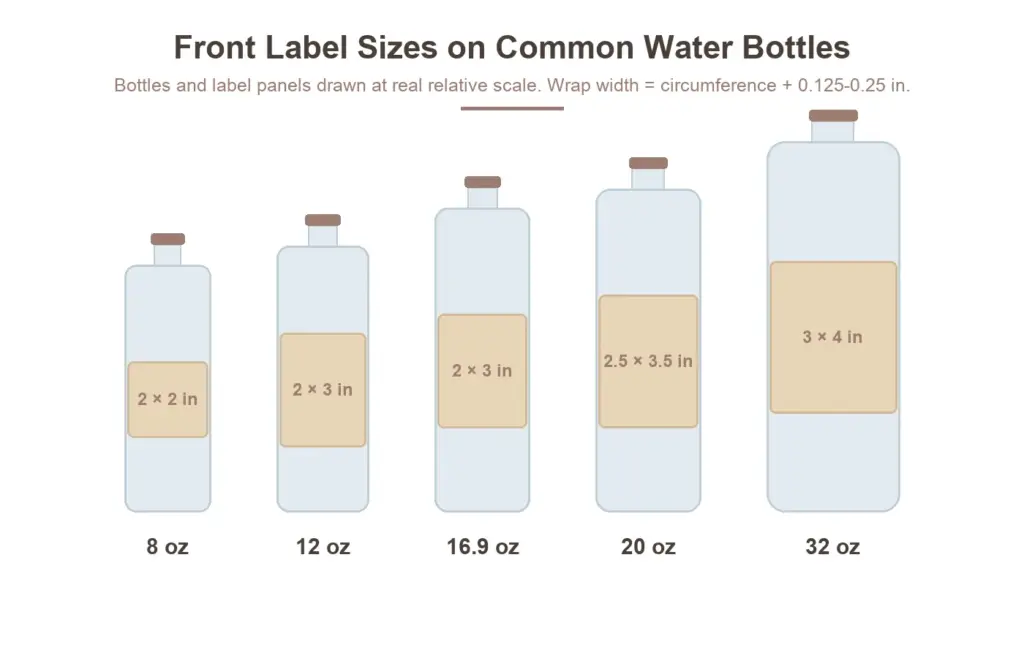
The bottle’s straight side, not the designer, decides how tall a water bottle label can be.
Two label styles appear throughout this chart. A front label is a single panel on the bottle’s face; a full wrap travels all the way around and meets itself at the back. The numbers below are reference values for standard stock bottles: molds vary slightly by supplier, so confirm against your actual bottle before printing, which takes one minute with a tape measure.
| Capacity | Bottle Height × Diameter | Front Label | Full Wrap |
|---|---|---|---|
| 2 oz | 3.5 to 4 × 1.2 to 1.4 in | 1 × 2 in | 4.25 × 1 in |
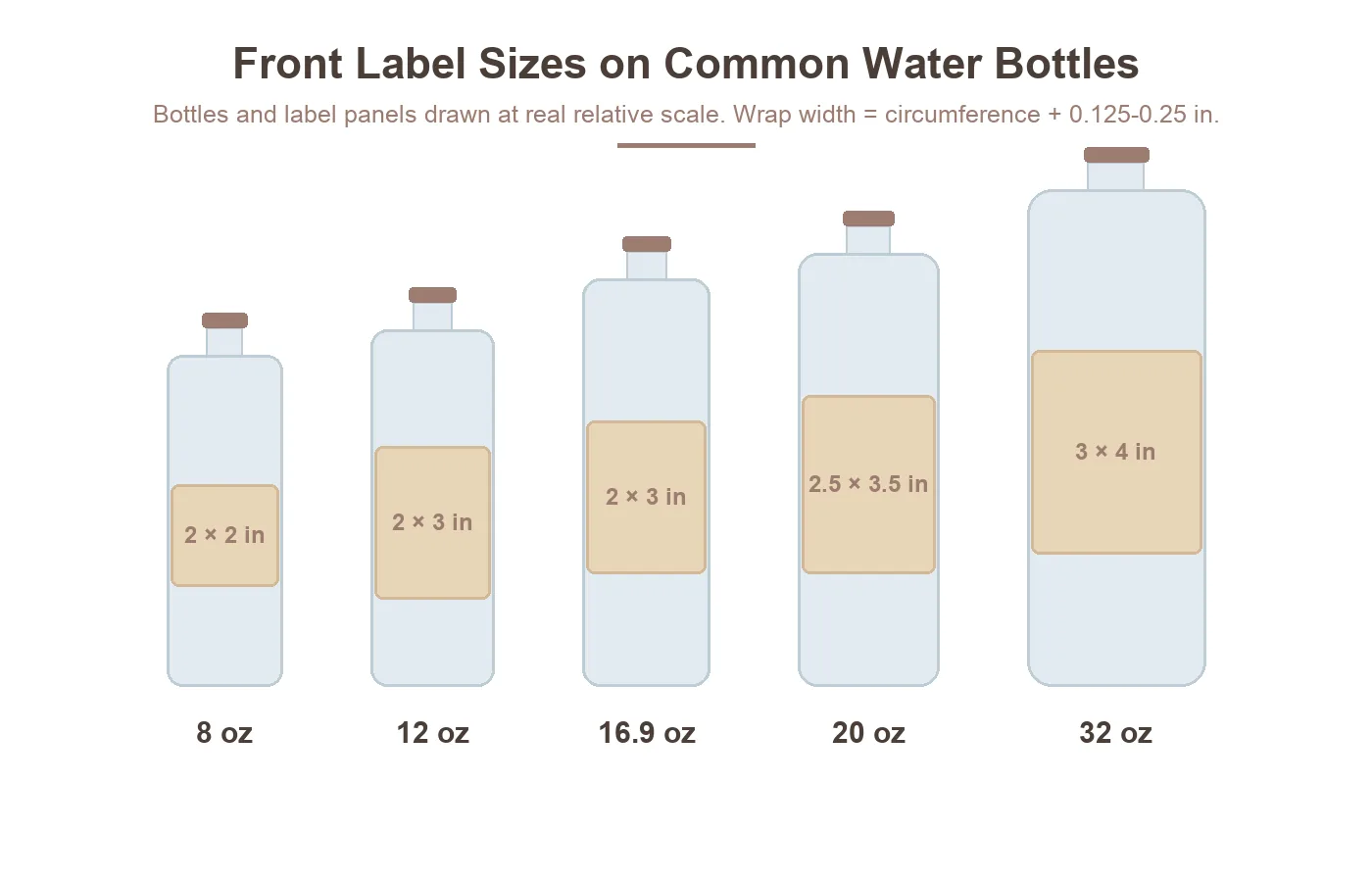
| 8 oz | 6.5 × 2.25 in | 2 × 2 in | 7.25 to 7.5 × 2 in |
| 12 oz | 6.75 to 7 × 2.4 to 2.5 in | 2 × 3 in | 8 × 2 in |
| 16 oz | 8 × 2.5 in | 2 × 3 in | 8 to 8.25 × 2 in |
| 20 oz | 8.25 to 8.5 × 2.75 in | 2.5 × 3.5 in | 8.75 to 9 × 3 in |
| 32 oz | 9.75 × 3.5 in | 3 × 4 in | 11.25 × 3.5 in |
| 1 gallon | 11.5 to 12.5 × 6 to 6.3 in | 4 × 6 in | Front and back panels |
2 oz Bottle Label Size
The 2 oz bottle is a party and sampling size, and it leaves room for very little. A 1 × 2 inch front label carries a logo and a name, which is all this bottle is asked to do. Brands that want continuous graphics use a 4.25 × 1 inch wrap that circles the mini bottle once.
8 oz Bottle Label Size
The 8 oz bottle is the classic kids’ size and juice-cup substitute. Its straight side takes a 2 × 2 inch front label comfortably; going taller on a 6.5 inch bottle crowds the neck. A 7.25 to 7.5 × 2 inch wrap is the standard full-coverage choice. For school events and party favors, this is also the size where per-label cost matters most, since orders tend to run in the hundreds.
12 oz Bottle Label Size
The 12 oz can-shaped bottle carries a 2 × 3 inch front label, the same workhorse size used on countless products. If your design runs horizontally, an 8 × 2 inch wrap turns the whole bottle into the label, which suits brands whose artwork is wide rather than tall.
16 oz Bottle Label Size
The 16 oz bottle is the most common custom water bottle in the United States, and its label sizes are effectively settled. Print a 2 × 3 inch front label, or an 8 to 8.25 × 2 inch full wrap sized to the bottle’s roughly 8 inch circumference plus a short overlap. Event planners and hotels order this size more than any other.
20 oz Bottle Label Size
The 20 oz sports bottle is slightly taller and wider, so the front label grows to 2.5 × 3.5 inches and the wrap to about 8.75 to 9 × 3 inches. This is the capacity where shoulder curves start eating into the panel, so resist pushing the label height past the straight wall.
32 oz Bottle Label Size
The 32 oz bottle, popular with gyms and outdoor brands, has a wide 3.5 inch body that supports a 3 × 4 inch front label. Full coverage takes an 11.25 × 3.5 inch wrap. At this size the label is a real surface for design, so many brands run photography instead of a plain logo.
1 Gallon Bottle Label Size
The 1 gallon jug plays by different rules. It is too wide for a single wrap to look good and it usually carries a handle, so the standard treatment is a 4 × 6 inch label on the front face and a second panel on the back for required details. Keep both clear of the handle and the molded base ring, where ridges and curves interfere with adhesion.
How to Measure a Water Bottle for a Label
Two numbers size any bottle label: the straight panel height and the circumference.
You need a flexible tape measure and two minutes. Height comes first: hold the tape beside the bottle and measure only the straight section between the shoulder curve at the top and the base curve at the bottom. That straight section is the label panel, and any label taller than it will wrinkle or lift at the curves.
Width comes from the circumference, which you measure by wrapping the tape once around the bottle at label height. Since one inch equals 25.4 mm, the same math works in either unit. A front label should stay under half the circumference; a full wrap should equal the circumference plus 0.125 to 0.25 inches of overlap so the label can close on itself. If you only have the diameter, multiply it by 3.14 to get the circumference.
Material and shape questions follow the same measuring logic, and the guide to choosing bottle labels covers them for glass and plastic alike. For water bottles specifically, note the panel is often shorter than it looks, because the shoulder on a sleek bottle starts high; measure, never estimate.
How Much of the Bottle Should the Label Cover?
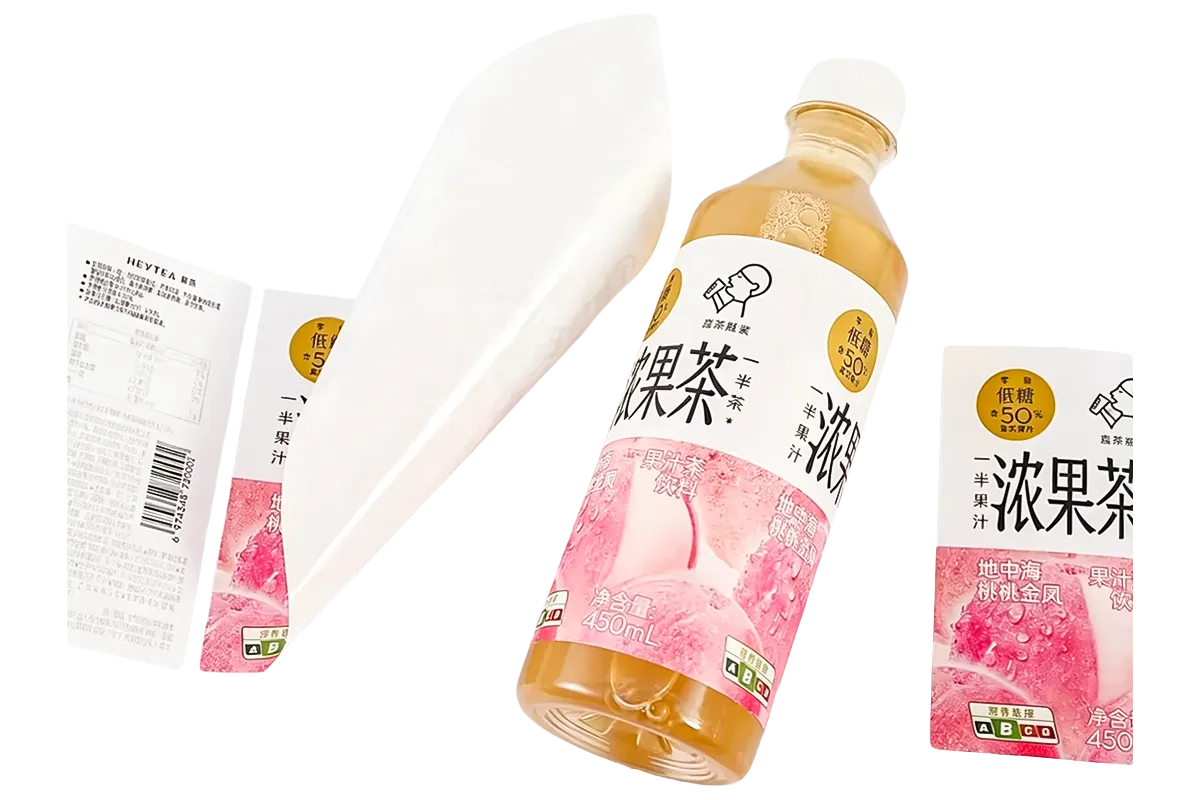
A front label under half the circumference looks sharp; past halfway it starts to warp.
Coverage is a design decision with physical limits. Under half the circumference, a front label reads as a clean panel and the bottle still shows its contents or its color. Push past halfway and the artwork begins to wrap around the sides, where it distorts and the edges visibly fight the curve.
Height deserves the same restraint. Leave at least a finger width of clearance below the shoulder curve and above the base, so the label sits entirely on the straight wall. Bottles that go through repeated refrigeration and condensation punish labels that touch the curves, because that is where moisture collects and edges lift first.
Brands read these limits differently, and both instincts have a home here. Minimal designs use a small front panel with plenty of bottle showing, while sports and event brands cover as much of the cylinder as the panel allows. Either way, the half-circumference and straight-wall rules, not taste, draw the outer boundary.
Get Water Bottle Labels Sized Right the First Time

Wrap-Around vs. Front-and-Back Water Bottle Labels
One wrap labels every side a shopper turns; two panels split the story between front and back.
A wrap-around label is a single piece sized to the full circumference, so the bottle looks finished from every angle and the seam hides at the back. It suits retail shelves, where bottles stand in rows and shoppers turn them. A front-and-back pair uses two smaller panels: the front carries the brand, the back carries ingredients, nutrition facts, or batch details, which keeps each panel uncrowded.
The practical trade-offs are simple. Wraps cost more per bottle because they use more material, and they need the circumference measured accurately at every reorder. Panel pairs cost less, apply faster on modest equipment, and give regulated text its own space, which is why the 1 gallon jug in the chart above defaults to panels rather than a wrap. Every format below ships from the labels & stickers category in waterproof films and papers.
| Format | Sizing Rule | Best For |
|---|---|---|
| Full wrap | Circumference plus 0.125 to 0.25 in overlap | Shelf impact, all-around graphics |
| Front and back | Two panels within the straight panel height | Required text, gallon jugs |
| Front only | Half the circumference or less | Events, samples, simple SKUs |
A quick example sorts the two. A hotel amenity brand labeling thousands of identical 16 oz bottles wants them applied fast, so it prints front panels and saves the difference. A fitness brand that wants its bottle readable from a gym bag across the room pays for the wrap instead.
What to Check Before Ordering Water Bottle Labels
Condensation, refrigeration, and application speed break more bottle labels than sizing errors do.
Run this short list before the order goes in, with the bottle in hand.
- Confirm the bottle against the chart: molds vary by supplier, so measure your actual panel height and circumference rather than trusting a catalog alone.
- Plan for cold and wet conditions: chilled bottles sweat, so pick a waterproof film or laminate, as covered in the guide to making waterproof labels.
- Match the application method: hand application works from sheets, while machine application needs rolls wound in the correct direction, as explained for roll labels for automated labeling.
- Test on a real bottle from the actual production batch, including a night in the refrigerator, before approving the full run.
- Quote the size and quantity together, because unit pricing shifts with both, and a slightly smaller label often prints more to a sheet.
A wet-label failure is the most public kind, because it happens in the customer’s hand. The two-minute fridge test and the material choice prevent nearly all of them, and any printer who skips both checks is saving you nothing.
Water Bottle Label Size FAQ
What Size Label Do I Need for a 16 oz Water Bottle?
A 2 × 3 inch front label is the standard choice for a 16 oz water bottle. For full coverage, use an 8 to 8.25 × 2 inch wrap sized to the bottle’s circumference plus a short overlap.
What Size Label Fits a 12 oz Bottle?
A 2 × 3 inch front label fits a 12 oz bottle well. Wide designs work better as an 8 × 2 inch full wrap that circles the bottle once.
How Do You Measure a Bottle for a Label?
Measure the straight panel between the shoulder curve and the base for the label height, then wrap a tape once around the bottle for the circumference. Keep front labels under half the circumference and size wraps to the full circumference plus 0.125 to 0.25 inches of overlap.
How Much Overlap Should a Wrap-Around Label Have?
A wrap-around label needs 0.125 to 0.25 inches of overlap past the full circumference so the label closes on itself and the seam stays sealed through handling and refrigeration.
Can Paper Labels Survive Refrigeration and Condensation?
Plain paper labels usually fail on chilled bottles, because condensation collects under the edges. Waterproof films or laminated papers built for wet conditions hold up through refrigeration and ice buckets.
What Is the Difference Between Wrap-Around and Front-and-Back Labels?
A wrap-around label is one piece sized to the full bottle circumference, so graphics continue around every side. Front-and-back labels are two smaller panels, with the brand on the front and details like ingredients on the back, which suits regulated text and wide bottles.
Conclusion
Every capacity in this chart has a label size that simply works: a 2 × 3 inch front on the 16 oz standard, an 8 × 2 inch wrap where full coverage matters, a 4 × 6 inch panel pair on the gallon jug. The chart’s numbers are proven starting points, and your tape measure turns them into a confirmed spec in two minutes.
Measure the straight panel, keep front labels under half the circumference, add a short overlap to wraps, and choose a material that survives the cooler. Those four habits cover nearly every water bottle label order, and when a bottle sits between two sizes, quoting both settles it with the unit price.
With the size and shape settled, ask Meikei to quote the shortlist. One message with the artwork and the surface it lands on returns the size, material, and finish together.