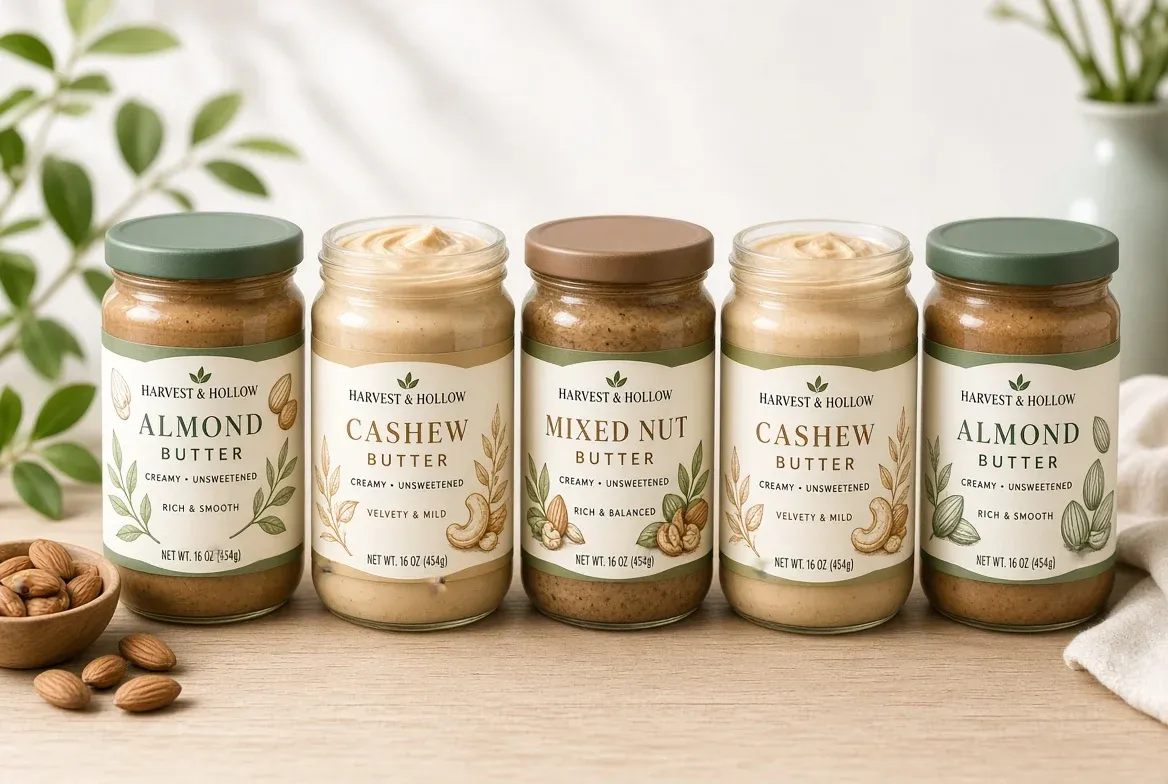
Nut butter jars look simple until you spec the label. The oil wants to bleed through, the round panel wants to distort the artwork, and the reorder wants to arrive identical to the last run. Peanut butter and nut butter labels combine a sizing problem, a material problem, and a bulk-ordering problem in one small panel.
This guide covers the three in order: jar shapes and label dimensions, material choices for oily products, and the specifications that make bulk orders repeatable. It ends with the details the label has to carry and where they sit, because a nut butter label is half marketing and half compliance document.
Common Jar Shapes and Label Panel Dimensions
Nut butter jars come in a small set of shapes, and each shape has a label panel that must be measured, not guessed.
The shapes repeat across the industry, but the dimensions do not, because every jar maker draws the shoulder and base a little differently. The label that fits brand A’s 16 oz jar can hang over brand B’s by an eighth of an inch.
The Standard Nut Butter Jars
The category runs on straight-walled round jars in a handful of capacities: 16 oz is the retail anchor, with 26 to 28 oz and 40 oz family formats above it, and 8 to 12 oz small formats below. Squat wide-mouth jars sit beside taller straight jars, and the two shapes take very different label heights.
Measuring the Panel
Measure the straight-wall area between the jar’s shoulder and base, then record the circumference at the intended label position. Allow for the required overlap when preparing the wraparound dieline. The wrap dimension is the circumference at the label’s position, with the overlap added separately. A wrap label that fits the drawing but not the jar costs the whole run.
Sizing to the Capacity
Label height scales with the jar’s straight wall: 16 oz jars commonly take a three-to-four-inch label, 40 oz jars take five inches or more, and small 8 oz jars take a band under three inches. See our article on jar label sizes by capacity for the full reference, and our chart on standard label sizes for the surrounding conventions. The quick reference below covers the common retail formats.
| Jar Capacity | Typical Label Height | Common Layout |
|---|---|---|
| 8 to 12 oz | Under 3 pollici | Front label with back details |
| 16 oz | 3 to 4 pollici | Front-and-back pair |
| 26 to 28 oz | 4 to 5 pollici | Wraparound or pair |
| 40 oz and club sizes | 5 inches and up | Wraparound label |
These are starting points measured from common jars. Every brand confirms the numbers against its own container before artwork begins.
Front, Back, and Wraparound Label Layouts
Layouts split the required content between surfaces: a front-and-back pair gives each message room, a wraparound keeps one surface continuous.
Front-and-Back Pairs
The front label typically displays the brand, product name, and net quantity, while the back label carries the ingredient list, Nutrition Facts, allergen information, and manufacturer or distributor details. This layout gives the product a clear front-facing presentation while keeping detailed information organized on the back panel.
Wraparound Labels
A wraparound label runs most of the way around the jar, carrying brand and compliance on one continuous panel. It gives more design room but has to keep the required text out of the overlap seam and away from the panel’s curve at both ends. The wraparound reads as one story when the jar turns, which is exactly its selling point on the shelf.
Layout Zones and the Overlap
Every wrap layout defines three zones: the front read, the back read, and the overlap, where the label’s tail hides under its head. Text in the overlap zone is unreadable, so barcodes and ingredient lists stay clear of it. The zones get marked on the dieline before artwork starts.
Material and Adhesive Choices for Oily Nut Butter Products
Nut butter oil is the label’s permanent roommate: the facestock has to resist staining and the adhesive has to hold through it.
The oil starts separating from the product on day one, and it finds every gap in the construction before the label is a month old. The material section below closes those gaps in order.
Film Over Paper
BOPP film is the standard facestock for nut butter labels, because the oil that separates from the product stains paper through the jar’s whole life. A matte or gloss laminate over the print keeps the surface clean and the barcode scannable. Paper labels survive only in dry, premium lines where the oil load is managed, and even there the laminate does the real work.
Adhesives for Oily Jars
Nut butter jars meet oil at the fill line and again at the breakfast table, so the adhesive has to be oil-tolerant and matched to the jar surface, glass or plastic. The bond gets specified for the messiest jar in the batch, because the label that holds on the clean jar is not the label that holds on the real one. See our article on what materials are used for custom stickers for the full facestock-and-adhesive pairing picture.
Finishes That Stay Clean
Gloss laminate wipes clean easily, matte laminate hides fingerprints, and both stop the oil from reaching the ink. The finish choice on a nut butter label is a cleanability choice first and an aesthetic choice second.
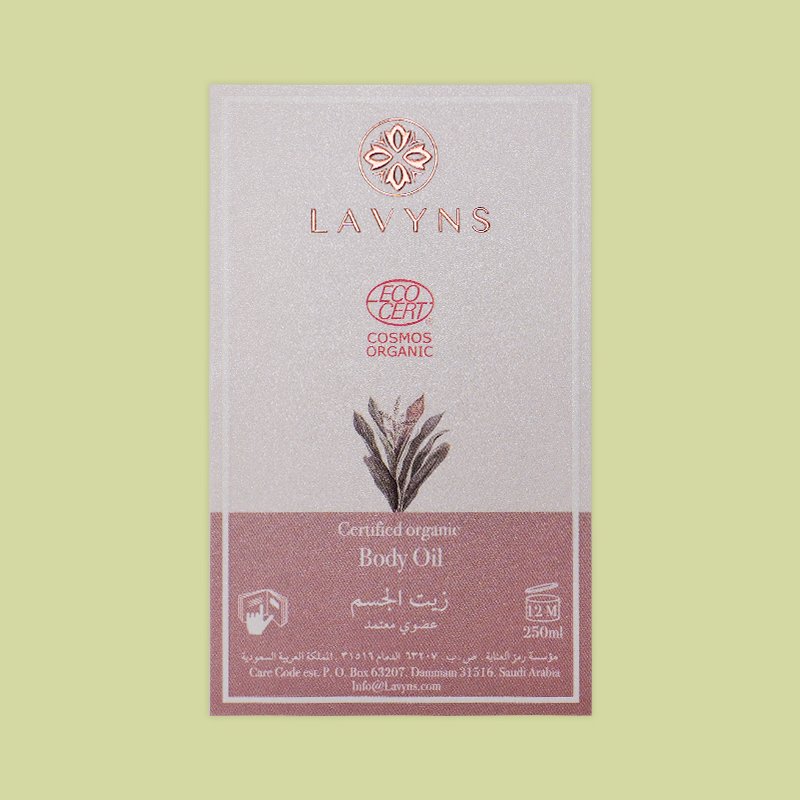
Nut Butter Labels Built for the Oily Jar
Required Product Details and Readable Label Layout
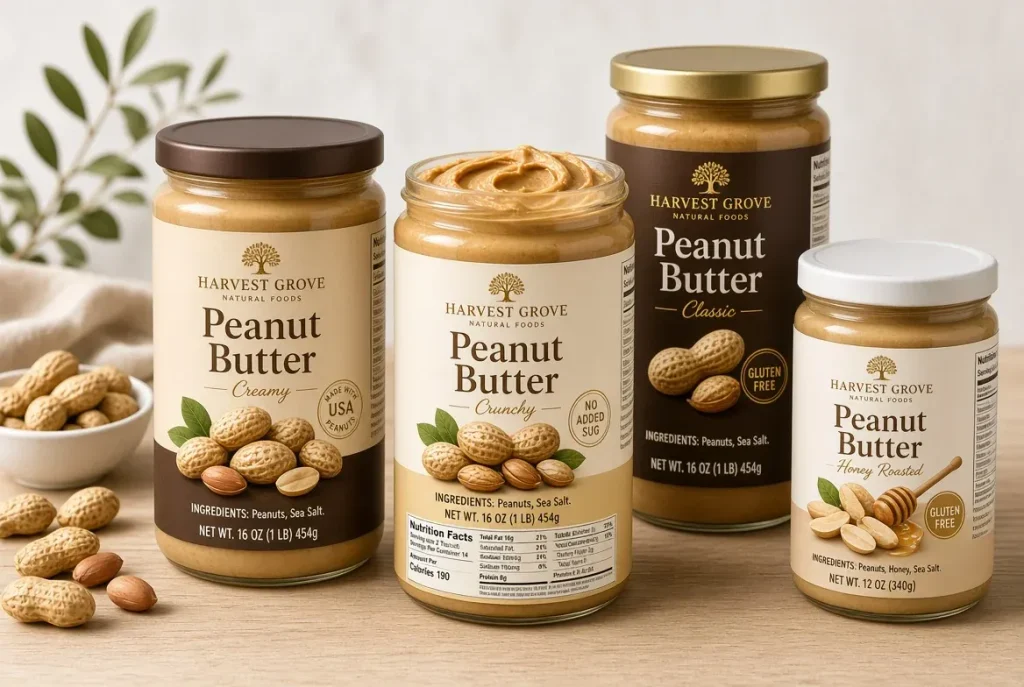
Compliance text earns its place on the jar: identity, ingredients, allergens, net weight, and nutrition all print at readable sizes.
The Required Set
Nut butter labels carry the product identity, net weight, ingredient list with the peanut or tree nut allergen called out, nutrition facts, and the manufacturer or distributor details. The requirements follow the food labeling rules of the destination market, with the US framework set out in 21 CFR Part 101. Each element needs a minimum type size that survives the jar’s curve.
Keeping the Back Panel Readable
The back panel is the unglamorous half of the label and the one regulators read first. Ingredients and nutrition get their own block with generous leading, and the allergen callout stands out in bold. The layout’s success test is simple: a shopper can read every required line at arm’s length. If the brand team squints at the proof, the panel gets reworked before plates are made.
The Curve and the Barcode
Round jars curve the artwork, and the barcode suffers most on the curve’s edges. The code sits on the flattest part of the panel, sized up and kept out of the overlap. A nut butter jar’s barcode that scans on the proof must also scan wrapped on the jar, because the curve changes the geometry the scanner sees.
Bulk Order Specifications, MOQ, and Reorder Planning
Bulk ordering is about repeatability: the same size, materiale, and finish on every reorder, priced on a volume ladder that rewards planning.
Nut butter brands reorder for years on the same jar, so the ordering side of the label program pays back every discipline invested in it. The three habits below are the whole system.
Writing the Order Spec
The order spec names the size, facestock, adesivo, laminate, and quantity, plus the roll format if the labels run on a machine. A complete spec is what makes two orders three months apart print identically, and it is the document suppliers quote against. The spec is written once and reused for every reorder.
MOQ and the Volume Ladder
Minimum order quantities on custom labels come mostly from press setup, so unit prices drop in steps as the order climbs the volume ladder. Buying two sizes together on the same material can lift the combined volume into a better price step, which is worth asking about in the quote. The quote request should therefore list all sizes in the range, not one at a time.
Reorder Planning
Nut butter brands reorder on a schedule, so the smart move is approving the next order against a retained standard sample before stock runs low. The retained sample catches drift early, and the documented spec makes the reorder a formality instead of a redesign. Stock planning follows the lead time, with the label order placed before the jar order needs it.
Domande frequenti
What information should be included on a peanut butter label?
A peanut butter label typically includes the product name, net weight, ingredient list, allergen declaration, nutrition facts, manufacturer or distributor details, and any required storage instructions. The exact requirements depend on the destination market. Leave enough space for mandatory information when planning the label layout, especially on smaller jars.
What is the typical size of a peanut butter jar?
The retail anchor is the 16 oz jar, with 26 to 28 oz and 40 oz family sizes common above it and 8 to 12 oz small sizes below. Physical dimensions vary by manufacturer, which is why label sizing always starts from the specific jar. The capacity tells you the family; the measurement tells you the label.
How big is a 16 oz jar of peanut butter?
A typical 16 oz peanut butter jar is around three to four inches tall with a similar diameter, depending on the manufacturer’s shape. The label panel is the straight wall between shoulder and base. Exact dimensions vary enough between suppliers that measuring the actual jar is the only safe way to size the label.
What size label for 16 oz Mason jar?
UN 16 oz regular-mouth Mason jar takes a label around two to three inches tall and wide enough to leave a comfortable margin on the curved glass. The exact fit depends on whether the label goes front-only or wraps around. Measuring the flat area on the actual jar beats any chart for the final size.
What size labels for 8oz jars?
Small 8 oz jars take compact labels, commonly a two-to-three-inch front label or a narrow band wrap, depending on the jar’s height. The label has to carry the same required information in less space, so hierarchy and type size get planned first. Small jars punish busy artwork fastest.
What are the best labels for mason jars?
Waterproof film labels with glass-rated adhesives are the best general choice for Mason jars, because jars meet condensation, washing, and fridge storage. For dry pantry use, coated paper labels work and carry a craft look. The jar’s journey decides between the two.
How do you measure a jar for a wraparound label?
Measure the circumference at the intended label position and the available straight-wall height between the jar’s shoulder and base. Add the required overlap to the wrap dimension when preparing the dieline, and leave clearance around curved edges or seams. Check the measurements against the actual container before approving the label artwork.
What materials are best for peanut butter jar labels?
Film materials such as BOPP are suitable for peanut butter jar labels that need moisture and oil resistance. Coated paper can work for dry storage and products with less demanding handling conditions. The adhesive also needs to match the jar surface and application temperature. Test the complete label construction on filled jars before placing a bulk order.
Conclusion
Nut butter labels reward the brands that treat them as a spec. The jar gets measured, the film and oil-tolerant adhesive get chosen, the compliance text gets placed for reading, and the reorder gets locked to a retained sample. The label that survives the oily jar and the bulk reorder is the one that was planned twice.
For nut butter brands ordering labels in bulk, Meikei prints oil-resistant jar labels to measured panels, with volume pricing and reorder consistency across runs.