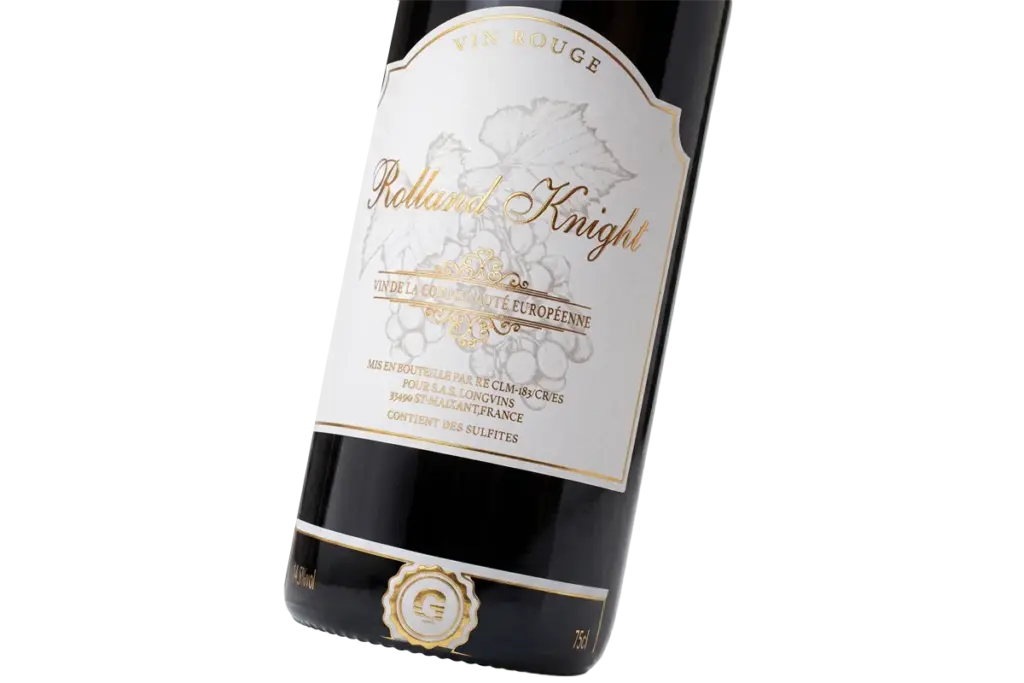
Ordering labels for the first time is easier than it looks, because most products end up using labels from one short list. Printers keep cutting tools and sheet layouts ready for these standard sizes, so they cost less, quote faster, and turn around more quickly than odd dimensions nobody stocks.
This guide lists the common label sizes in inches and millimeters, grouped first by shape and then by the kind of product they suit. If you are new to labels, find the container you are labeling in the second half, note the sizes next to it. You will have a workable shortlist within a few minutes. For the broader decision beyond dimensions, the guide on what label size to choose for packaging walks through the full process.
Standard Label Sizes Chart
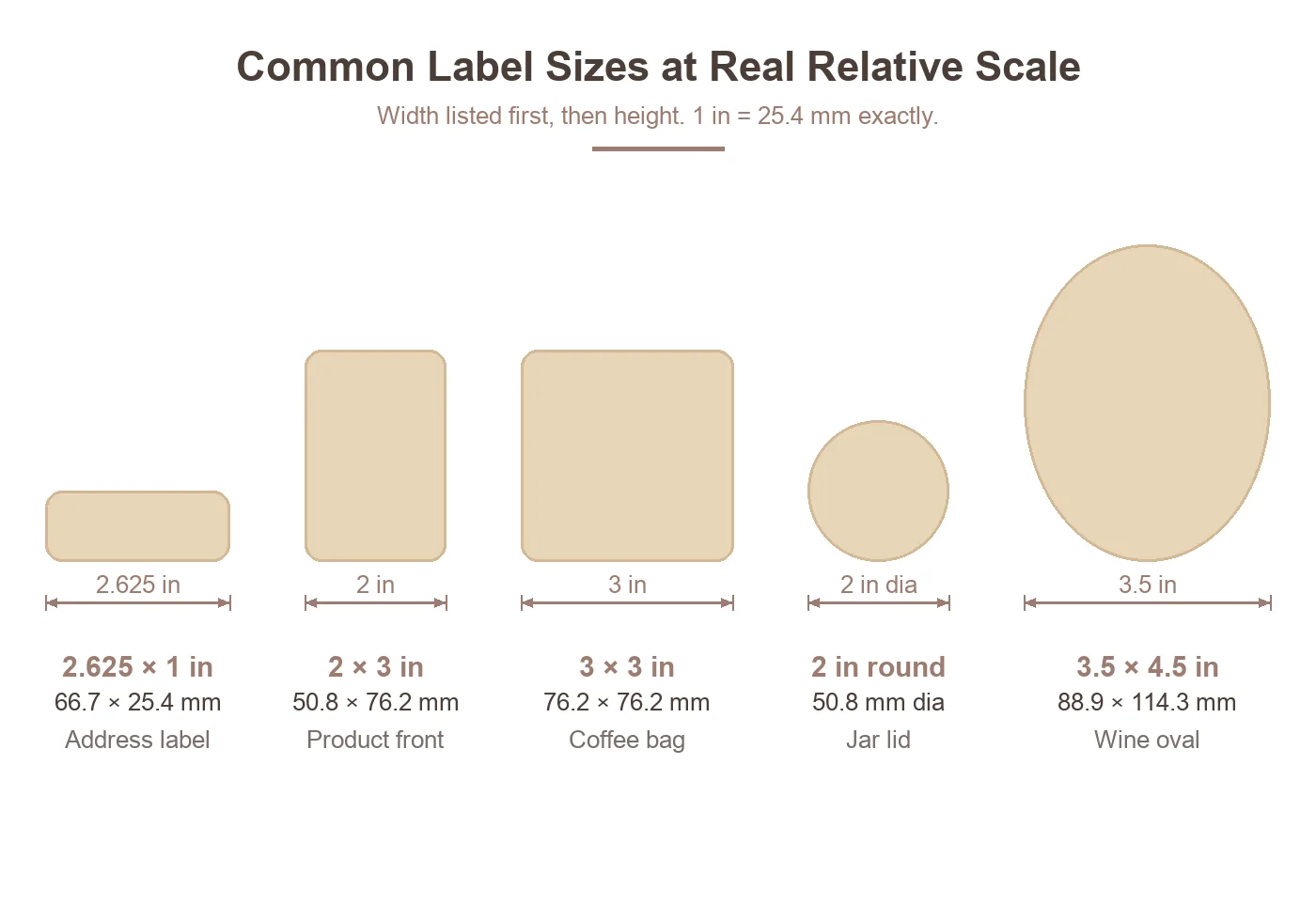
A short list of sizes covers most products, because printers keep cutting tools ready for them.
Label sizes are written width first, then height, measured across the finished label while it is still flat. Rounds are given as a single number, the diameter. Since one inch equals 25.4 mm exactly, every conversion in these tables is exact, so you can order in either unit without rounding surprises.
Common Rectangle Label Sizes
Rectangles are the most popular shape by a wide margin. They suit bottle fronts, jar fronts, boxes, and barcodes, and they use the space efficiently, so a logo and a product name never feel crowded. The 2 × 3 inch size is the single most ordered label of all: close to a business card, large enough for a brand and a flavor, small enough for most containers. The 4 × 6 inch size owns shipping, with the same proportions as a standard photo print.
| Size (inches) | Size (mm) | Usually used on |
|---|---|---|
| 1.5 × 2 | 38.1 × 50.8 | Small jars and vials |
| 2 × 3 | 50.8 × 76.2 | Product fronts, most popular |
| 2 × 4 | 50.8 × 101.6 | Bottles and barcode panels |
| 2.625 × 1 | 66.7 × 25.4 | Address labels |
| 3 × 4 | 76.2 × 101.6 | Jars and box fronts |
| 3.5 × 5 | 88.9 × 127 | Large jars and gift tags |
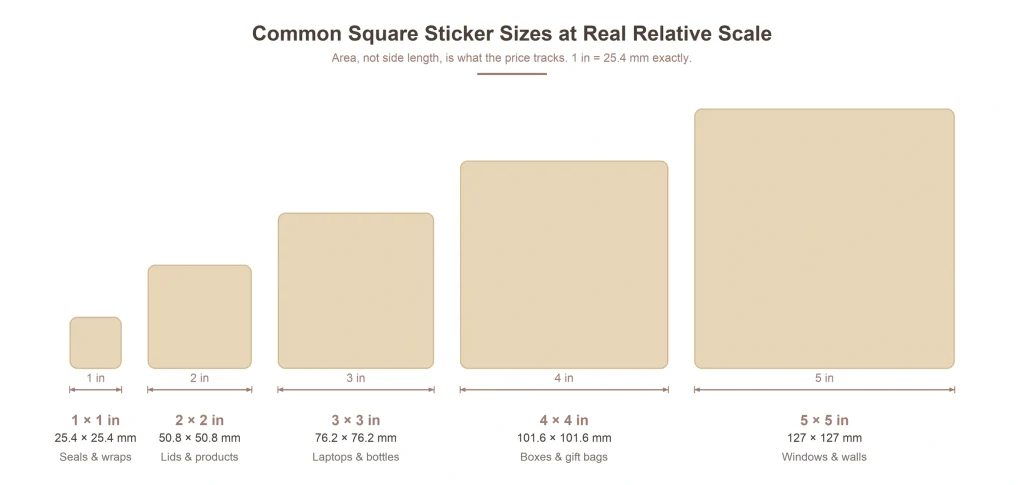
| Size (inches) | Size (mm) | Usually used on |
|---|---|---|
| 2 × 2 | 50.8 × 50.8 | Jar lids and seals |
| 2.5 × 2.5 | 63.5 × 63.5 | Cosmetic jars |
| 3 × 3 | 76.2 × 76.2 | Coffee bags and boxes |
| 4 × 4 | 101.6 × 101.6 | Pouches and gift boxes |
A quick word on lids: a square or round label should sit inside the lid’s flat center, not run to its edge. Paper and film both lift slightly where an edge hangs past a curve, and a label stays put longest when every side rests on flat metal or glass.
Common Round and Oval Label Sizes
Round labels are measured across, by diameter, and they look at home on lids, caps, and tin bases. Ovals are measured like rectangles, width then height, and they flatter tall or gently curved containers where a rectangle looks boxy and a circle looks lost. For scale, a 3 inch round is the same width as a hockey puck, which is why it reads clearly without taking over the package.
| Shape | Size (inches) | Size (mm) |
|---|---|---|
| Round | 1.5 dia | 38.1 dia |
| Round | 2 dia | 50.8 dia |
| Round | 2.5 dia | 63.5 dia |
| Round | 3 dia | 76.2 dia |
| Round | 4 dia | 101.6 dia |
| Oval | 1.5 × 2.5 | 38.1 × 63.5 |
| Oval | 2 × 3.33 | 50.8 × 84.6 |
| Oval | 3.5 × 4.5 | 88.9 × 114.3 |
As a quick rule between the two shapes: rounds belong on lids, caps, and anywhere a seal look fits. Ovals belong on bottles, where their length fills the front panel a circle would leave half empty.
Common Label Sizes by Label Application
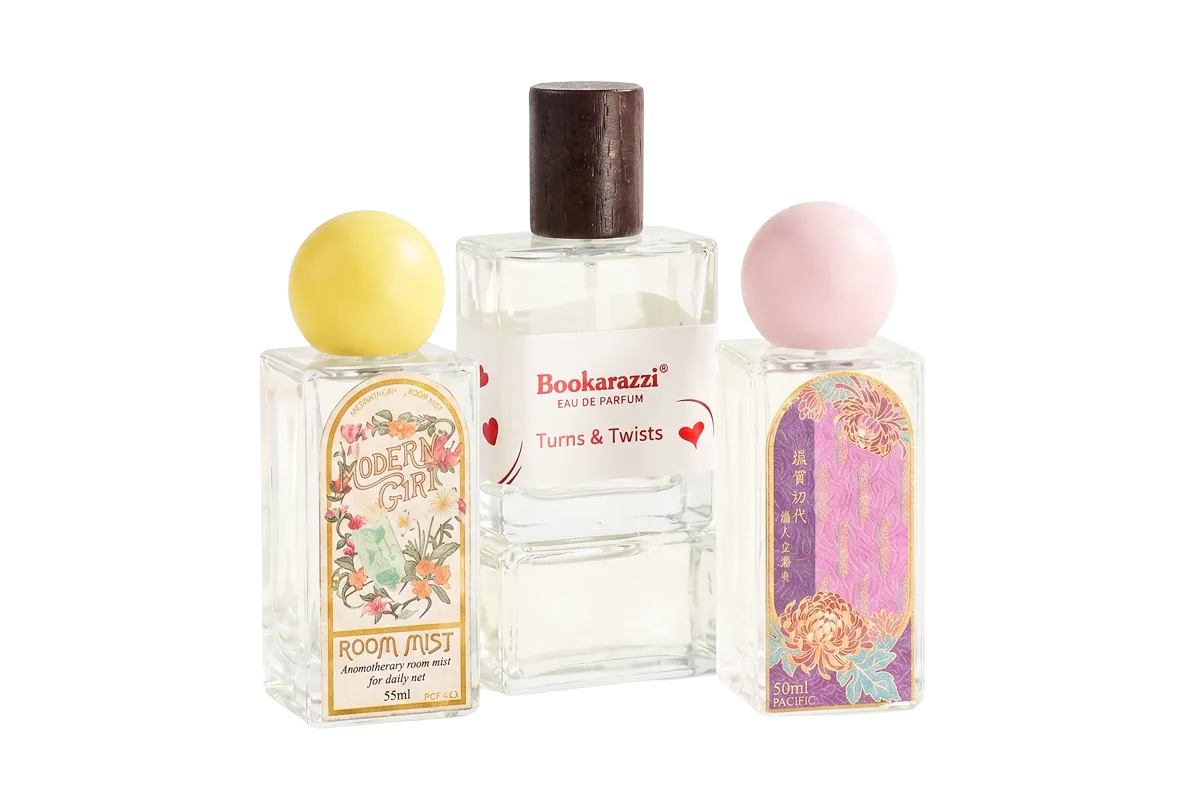
Pick the container first, and the label size almost picks itself.
Common Sizes for Product Labels
A product label has two jobs: catch the eye from across the shelf and stay readable up close. The sizes that balance both are 2 × 3 et 3 × 4 inches on the front, with 3 × 3 squares common on bags and boxes where a centered logo carries the design. If you also want the background on materials and finishes, the guide to custom labels is a good next read.
Plenty of brands split the work across two labels instead of one. The front label keeps the brand and the product name, while a back label carries the ingredients, directions, and barcode. Planning the pair together keeps the front clean and usually costs less, because both pieces fit on a single print sheet. A common approach pairs a 2 × 3 front with a smaller back panel in the same material, so the colors stay consistent. Every stocked size in the chart above is available across the labels & stickers category, so both panels can come from one supplier.
Common Sizes for Bottle and Jar Labels
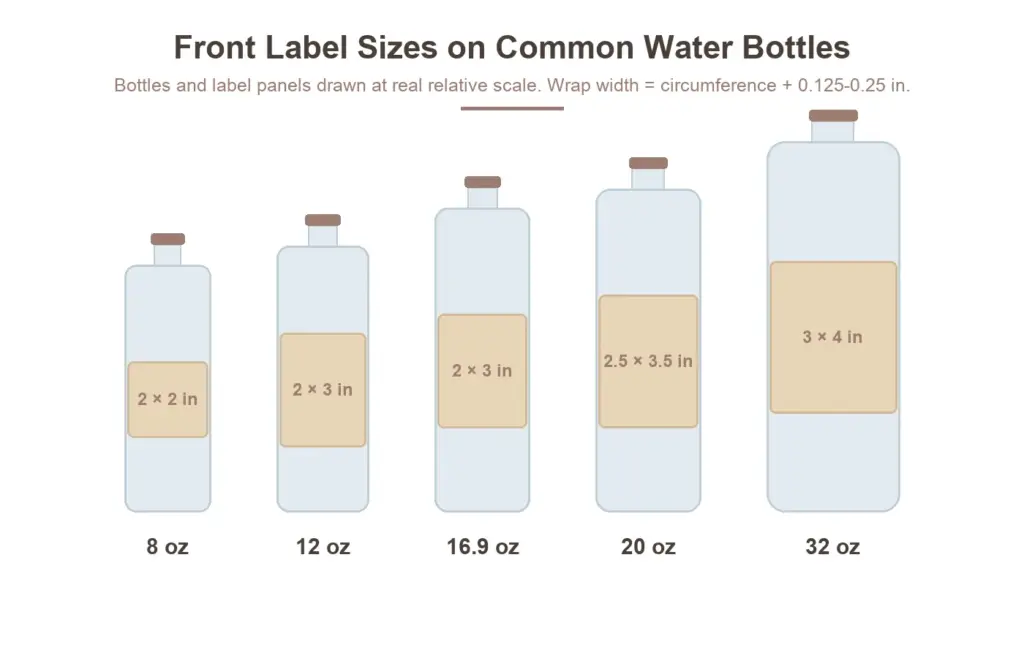
Curved containers set their own rules. On a bottle, the label lives on the smooth stretch between the shoulder curve and the base, so the panel height caps the label height. Jars under 8 oz usually take a 1.5 × 2 or 2 × 2 inch label, water bottles take a 2 × 3 front, and wine bottles carry a taller 3.5 × 4 inch front label shaped to the glass. For the full chart of mason, honey, and candle jars, see our guide on jar label sizes.
Width behaves differently on a bottle than on a box. Once a front label grows wider than about half the bottle’s circumference, the artwork starts to wrap around the sides and looks pinched at the edges. Jars sidestep the issue entirely, because their flat lids take round labels measured simply by diameter. For materials and adhesion on curved glass and plastic, the guide to choosing bottle labels covers the rest of the decision.
Bottle caps and necks have their own miniature sizes. The 1.5 et 2 inch rounds from the chart above are the usual picks for caps, and slim bands for the neck are ordered to match the bottle. These small pieces cost very little, so many brands use them as accent labels for batch numbers or a secondary logo.
Common Sizes for Box and Pouch Labels
Flat packaging offers more room to work with, so labels can run bigger without crowding the design. A 3 × 4 inch rectangle covers the front of a typical snack pouch, while 4 × 4 et 3.5 × 5 inch labels suit gift boxes and larger product packaging. These sizes provide enough space for product names, branding, ingredient details, and decorative elements without making the label feel cramped. On any of these flat surfaces, leave clear space around the barcode so scanners can read it accurately, and keep essential product information away from folds, seams, and edges.
The best label size still depends on the packaging dimensions and how much information needs to fit on the label. A smaller box may look better with a compact 3 × 3 inch label, while a larger gift box can accommodate a 4 × 4 inch design or a wider rectangular format. Before finalizing the dimensions, measure the available flat panel and consider how the label will look alongside other packaging elements. This helps maintain a balanced layout while keeping product details legible.
| Where the label goes | Sizes that work well | Why |
|---|---|---|
| Product fronts | 2 × 3, 3 × 3, 3 × 4 inches | Readable on the shelf |
| Bottles and jars | 1.5 × 2, 2 × 3, 3.5 × 4 inches | Fits available curved surfaces |
| Boxes and pouches | 3 × 4, 4 × 4, 3.5 × 5 inches | Makes good use of flat space |
Get the Right Label Size for Your Product
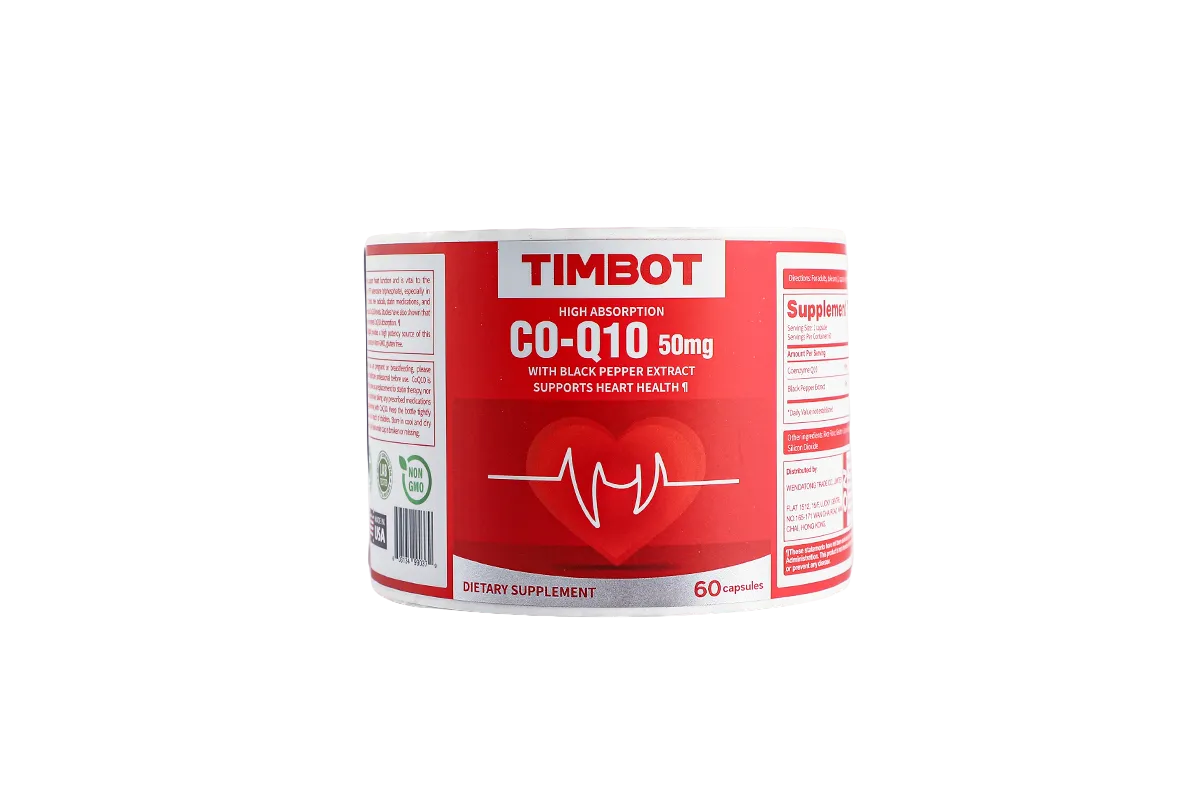
Standard Label Sizes vs. Custom Label Sizes
Standard sizes cost less because nothing new has to be made for your order.
A standard size is one the printer already produces regularly; a custom size is everything else. The difference shows up in price and schedule. A standard size reuses cutting tools and layouts the printer holds, while a custom size needs its own cutting path, a slower first proof, and a somewhat higher unit price at small quantities.
Custom sizes earn their extra cost in three everyday situations. The container has a short or tapered panel that standard heights overrun. A wrap-around design must match the bottle’s circumference exactly. Or the required text needs more room than the nearest standard size allows. Outside those cases, nudging the artwork to fit a standard size is almost always the better trade.
An example makes the trade concrete. A candle maker with a straight-sided jar can usually nudge the artwork half an inch and print on a stocked 3 × 4 die. A skincare brand with a tapered bottle has no stocked height that follows the taper cleanly, so the label gets cut to the bottle instead. Same order quantity, different logic, and both end up with the right label.
Quantity changes the math, too. At a few hundred labels, the setup behind a custom size is visible in each unit price. At thousands, it spreads so thin that the gap barely matters, and most printers will quote both options if you ask, which usually settles the decision on its own.
| What to compare | Standard size | Custom size |
|---|---|---|
| Cutting | Ready-made tools | New cutting path |
| Unit price | Lowest | Slightly higher |
| First proof | Quick | One extra check |
| Best for | Panels it fits | Tapered, wrapped, or text-heavy designs |
What to Check Before Ordering Labels
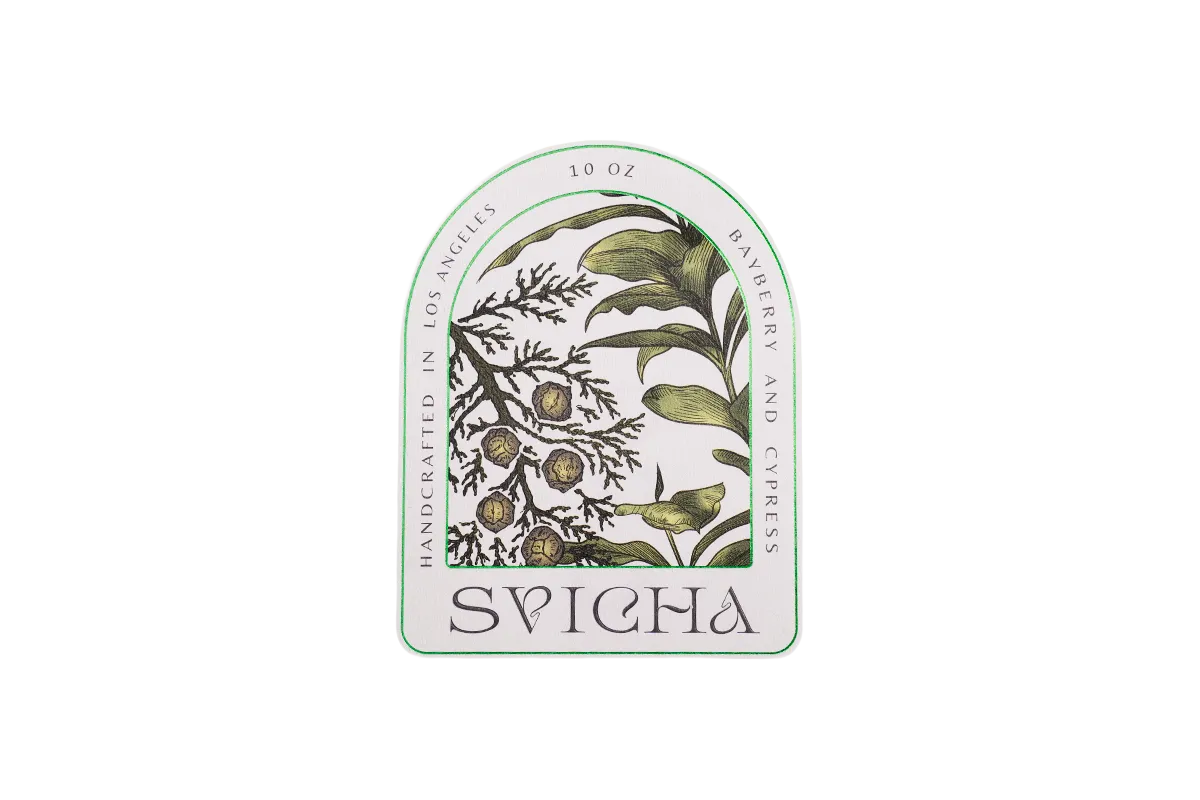
A quick check of three things prevents the most common label mistakes.
Before the order goes in, run through this short list with the actual container in hand.
- Confirm the flat panel: measure the smooth area between the curves and seams, then pick a label slightly smaller on every side.
- Match the shape to the surface: rectangles and ovals for bottles, squares and rounds for lids and flat box faces.
- Check the artwork size: design at the final label size and keep text well inside the edge, so nothing important sits on the cut line.
- Confirm the delivery format: rolls for machines, sheets or single pieces for hand application, as explained in the guide to roll labels for automated labeling.
- Ask for a sample on your actual container, because a size that looks right on screen can still wrinkle on a tapered bottle.
A physical proof closes every one of these gaps at once. A printed label on the real container shows curvature and fit problems that a screen cannot, and fixing them at the proof stage costs far less than a reprint. Printers who insist on this step are saving you money, not slowing you down.
Frequently Asked Questions About Label Sizes
What Is the Most Common Label Size?
The 2 × 3 inch rectangle is the most common product label size, offering a practical fit for a wide range of packaging and product types.
How Are Label Sizes Measured?
Label sizes are measured flat, width first and height second, across the finished label before it is applied. Round labels are given as a single diameter, and ovals follow the same width by height order as rectangles.
Can Labels Be Printed in Custom Sizes?
Yes. Custom label sizes are routine and simply need their own cutting path, which adds a modest setup cost over standard sizes. Custom sizing makes sense for tapered panels, exact bottle wraps, and text-heavy designs that standard sizes cannot fit.
Conclusion
Standard label sizes exist because they work for most products and keep printing simple and affordable. This chart gives you the full list in inches and exact millimeters, and three sizes cover a wide range of orders: the 2 × 3 rectangle, the 3 × 3 square, and the 2 inch round label.
The practical path is short. Choose the container, find its flat panel, pick the standard size that fits inside it, and go custom only when the fit, the wrap, or the required text leaves no standard option. Testing a sample on the actual container helps confirm the size before placing the full order.
When your shortlist is ready, run it past the Meikei team before you order. A size check and a printed sample on your actual package cost nothing and settle the last open questions.

Éric Zhang
Head of International Business Eric Zhang is the Head of International Business at our company, bringing over 5 years of hands-on experience in the custom labels and packaging industry. He specializes in delivering high-quality, innovative packaging solutions to global clients, with a strong focus on market expansion and understanding customer needs to help brands create distinctive product identities.